
The $2M Pipeline That Was Hiding in Bad CRM Data
The $2M Pipeline That Was Hiding in Bad CRM Data
One afternoon, we got a frantic call from a VP of Sales. "Something is seriously wrong with our pipeline forecast. My forecast shows $5.2M in opportunity value this quarter, but deal velocity is slower than we've ever seen it. And our sales team can't explain why." She had already spent hours in HubSpot looking for deals that fell through unexpectedly, trying to trace where the pipeline breakdown happened. What she actually found was way worse....... her entire CRM data was a mess.
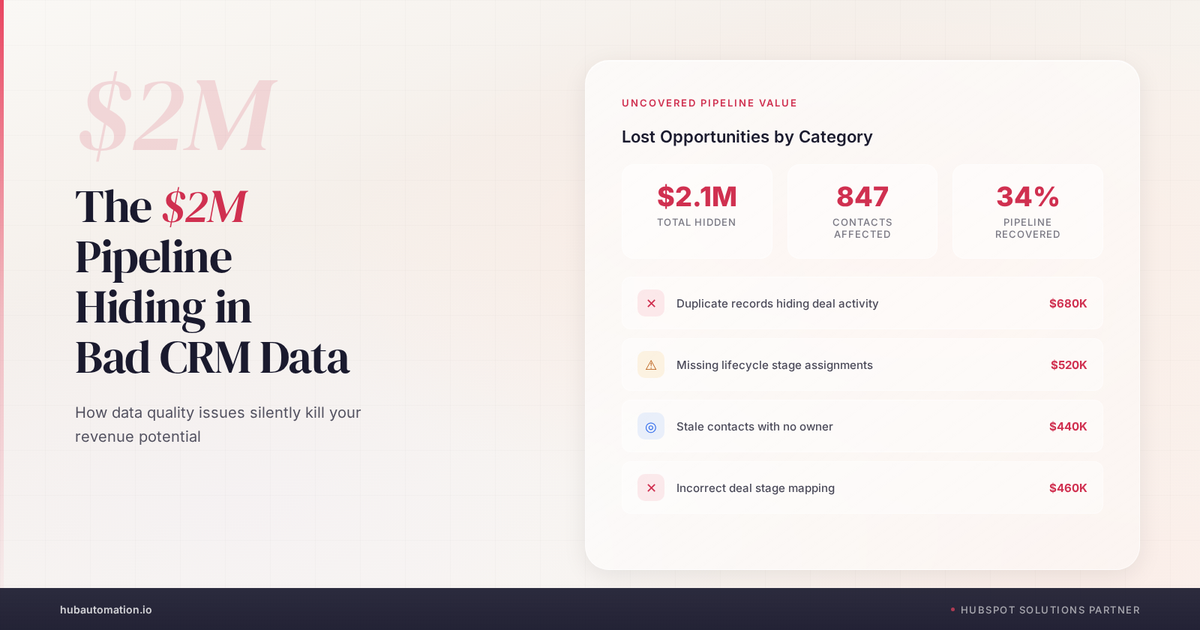
This is one of our favorite stories because it shows how bad data doesn't just hurt your forecasting, it literally hides revenue that's sitting right there in your CRM. When we audited their portal, we uncovered $2M in pipeline value that nobody could see. We like that. And the discovery process showed us exactly how bad data creeps in and what it costs.
The Discovery: What We Actually Found
We started with a comprehensive contact and deal data audit. This is methodical work, we exported 47,000 contacts and every open deal in their system, then ran them through our standard cleanliness checks. Here's what the numbers showed:
Duplicate Contacts: 23% of the Database
In a 47,000-contact database, we found 10,800 duplicate records. That's not a rounding error. That's more than one in five contacts existing multiple times in the system. How did this happen? Easy. Different sales reps adding the same prospect without checking if they already existed. Marketing campaigns creating duplicate records. Integrations from multiple data sources adding the same contact under slightly different data. Years of this accumulation, with nobody actively managing it.
The real damage wasn't that they had extra records, it was what those duplicates were doing to their processes. Sales reps were calling prospects they'd already called two weeks ago, not realizing they had a previous conversation because the history was split across two contact records. Emails were being sent twice to the same person. Tasks were being created twice. The entire system was bouncing around.
And honestly, the worst part? Important deal relationships were getting lost in those duplicates. We found 340 deals that were associated with a contact, but there was also a duplicate contact with different deal associations. That meant the total deal value for that contact was hidden across multiple records. Sales reps only saw the deals on the contact record they happened to be looking at.
Orphaned Deals: 67 Deals Worth $1.4M
We ran a report on all deals in their system and filtered for ones with missing company associations. Found 67 deals, SIXTY SEVEN, that existed in the system but had no company linked to them. Why? Usually because the deal was created before the company contact was added, or the company record got deleted, or a data migration went sideways.
But here's what killed us: Most of these deals were legitimate opportunities. We looked at the deal activity history. There were emails. There were calls. There were multiple task updates. This wasn't noise or garbage deals. These were REAL opportunities that the sales team was actively working, but management couldn't see them in their forecasts because they had no company association.
The pipeline value was RIGHT THERE: $1.4M across 67 deals. That's not pocket change.
Reassociated Deals: Another $620K Appears
Once we merged the duplicate contacts, we discovered another layer of problem. We had consolidated Customer A into one master record. But there were four different deals across the old duplicate records. Once merged, we could actually see the full relationship map.
We found 340 deals that were scattered across duplicate contact records. When we consolidated those contacts and properly reassociated the deals, suddenly there was a complete customer picture. And that picture revealed that the customer pipeline was WAY larger than anyone realized. $620K in additional deal value that was hidden because it was fragmented across orphaned records.
Data Quality Issues: The Systemic Problem
Beyond duplicates and orphaned deals, we found all the classic data quality issues:
23,000 contacts had blank email addresses. That's roughly half their database. For a sales-focused company, contact email is critical. Without it, you can't email them, you can't log activities, you can't track deliverability. These weren't bad contacts, they just had incomplete data that had never been completed during the sales process.
4,300 contacts had no phone number and no company name. Just a name field and nothing else. No way to actually contact them. No way to know what company they were associated with.
9,200 contacts had multiple phone numbers crammed into a single phone field instead of using HubSpot's structured phone fields. Sales reps couldn't tell which number was the mobile number, which was the office number. They had to manually parse it before calling.
And the deal data? 34% of open deals had no clear deal stage defined. The sales team was using the deal name field to note stage information instead of actually populating the stage field. "Chase, waiting on budget approval" was a deal name, not a stage. So when they ran forecasts, the system had no idea what stage these deals actually were in.
The Recovery Process: How We Found the Hidden $2M
This is the part where we actually earned our consulting fee. Recovering hidden pipeline value requires a very specific process. We didn't just clean data for the sake of it. We recovered revenue systematically.
Phase One: Duplicate Contact Reconciliation (Week 1)
We built a deduplication strategy based on email address as the primary key, then secondary matches on phone number and company name. For each duplicate set, we determined which record was the "master" based on data completeness and recency of activity. We then merged all activity history, deal associations, and contact properties into the master record.
This was NOT automated. Too much risk. We did this with a combination of data exports, HubSpot's merge features, and careful manual review. For the 10,800 duplicates, we created a reconciliation spreadsheet that the sales team reviewed. Any time we were uncertain, we flagged it and had a rep confirm before we merged.
Result: 47,000 contacts became 36,200 contacts. Everything else stays the same, no activity history lost, no relationships broken.
Phase Two: Orphaned Deal Recovery (Week 2)
For those 67 orphaned deals, we went back to activity history and email threads to figure out which company and contact they actually belonged to. Most of them had email communications that identified the company. A few were ambiguous, we had to make judgment calls based on deal value, associated contact names, and context.
Once we identified the correct company and primary contact, we reassociated the deals. Suddenly those $1.4M appeared on the forecast because they now had proper company relationships.
Phase Three: Deal Properties Cleanup (Week 2-3)
For all 340 deals scattered across duplicate records, we consolidated them under the master contact record. Then we populated the deal stage field properly for all 2,300 open deals. We created a standardized stage process: New, Qualified, Proposal Sent, Negotiating, Closed Won, Closed Lost. We moved every single deal to the appropriate stage based on its actual status.
That's when the $620K appeared. Suddenly the system could see deals that had been hidden in the data chaos.
Phase Four: Structural Prevention (Week 3-4)
Once the data was clean, we implemented processes to prevent it from getting messy again. We turned on HubSpot's duplicate merge alerts for contacts that look like duplicates. We built a required fields enforcement for deal creation, no deal could be created without a company association and a valid stage. We added phone and email as required fields when creating new contacts.
We set up a monthly data health check that flags deals with no company, contacts with no email, and other data quality issues. Preventive medicine, basically.
The Business Impact: What $2M Actually Means
Here's the thing about discovering hidden pipeline value: it changes how management thinks about forecasting. This VP of Sales wasn't just suddenly seeing extra deals. She was able to do something much more important, she could finally trust her forecast.
With $2M in previously hidden deals now visible, their total forecast went from $5.2M to $7.2M. That's a 38% increase in forecast visibility. But more importantly, she could NOW trace where deals were stuck, what was actually moving, and where the real bottlenecks were. When your data is a mess, you're literally flying blind.
Over the next two quarters, the company closed $1.8M of that previously hidden pipeline. They didn't win those deals because their salespeople suddenly got better. They won them because the deals became VISIBLE, got attention from management, got proper resources allocated, and moved forward as planned. When deals are orphaned and hidden, they just sit there. When they're visible, they move.
The contact deduplication also had a massive effect. Sales reps stopped chasing the same prospect twice. They stopped sending duplicate emails. They could see their full relationship history with a contact. That meant more effective calls, less wasted effort, and faster sales cycles. Just the efficiency gain from that alone was probably worth a percentage point or two of quota realization.
Why This Happens to Every Company (Yes, Yours Too)
We've done this audit for probably fifty companies at this point. And honestly, most of them are sitting on hidden pipeline. It's not because sales reps are careless. It's not because the company doesn't care about data quality. It's because data quality is a system problem, not a people problem. If your system doesn't enforce good data, your data will get bad. That's math.
We like that it's fixable, though. A proper data audit can typically uncover 8-12% of missing pipeline value. That's real money.
The companies that maintain clean data are the ones that have built it into their process. Required fields on deal creation. Duplicate alerts on contact add. Monthly audits. Data governance responsibility assigned to someone on the team. It's not hard, it's just intentional.
Ready to find YOUR hidden pipeline? Book a 1-Hour RevOps Strategy & Review Call with our team. We'll do a live walkthrough of your CRM data, identify where revenue is hiding, and map out a 2-Week RevOps Sprint to recover it. Most companies find $500K to $2M in pipeline they didn't know existed.
Want to see where your CRM is leaking revenue?
We run free 30-minute HubSpot diagnostics. Your portal, on screen, live. You leave with a prioritized fix list, yours to keep whether you hire us or not.
| Book my free 30-min audit |