
5 Signs Your Revenue Operations Are Costing You Deals
You're losing deals right now. Not next quarter. Not "eventually." Right now. And the worst part? You probably don't even know where the leak is. Your...
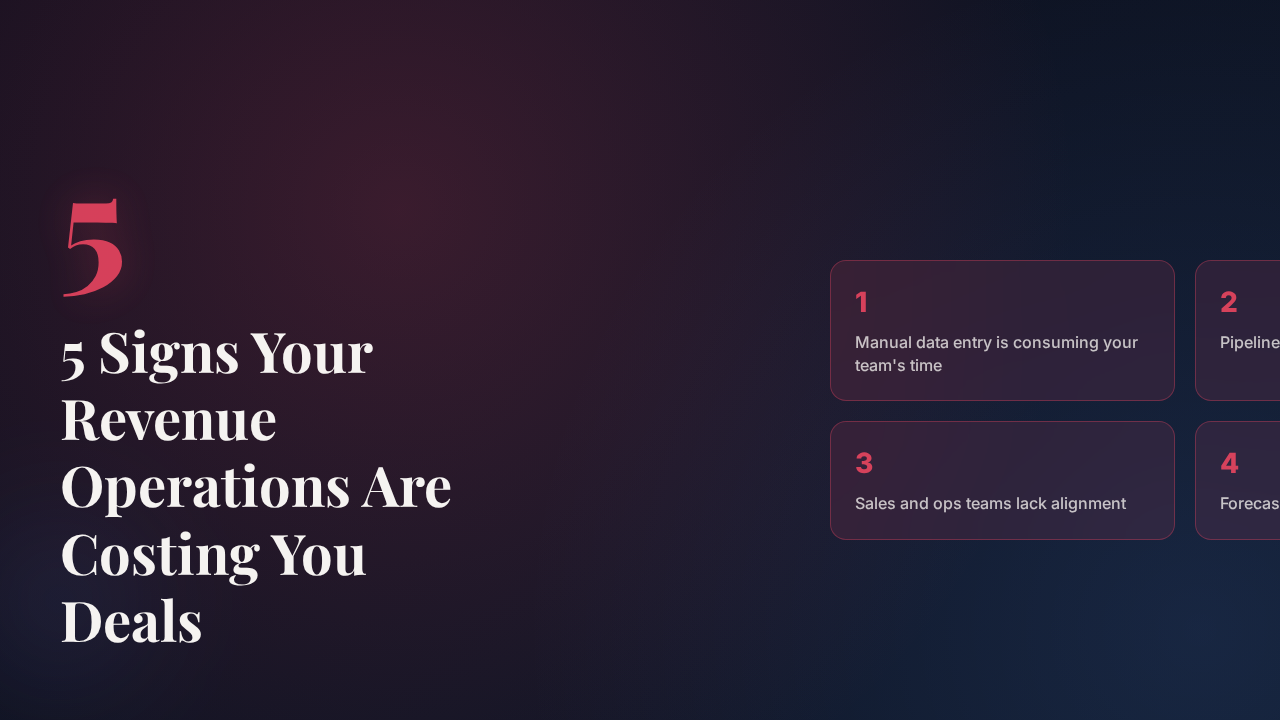
You're losing deals right now. Not next quarter. Not "eventually." Right now. And the worst part? You probably don't even know where the leak is. Your sales team is grinding, marketing is spending, and somewhere between "lead generated" and "closed won," revenue is quietly slipping through the cracks. We see this every single week in the portals we audit at HubAutomation. Companies with 30, 50, 100 employees who are doing A LOT of things right but bleeding revenue because their operations aren't connected. So today, we're breaking down the 5 signs that your revenue operations are actively costing you deals, and what to do about each one inside HubSpot.
Let's check it out.
The RevOps Problem Nobody Talks About
Here's the thing about revenue operations, or RevOps, as we'll call it from here on out. Most companies between 15 and 200 employees don't have a "RevOps problem" they can point to. They have a collection of small inefficiencies that compound into a BIG revenue problem. It's death by a thousand paper cuts.
RevOps is the strategic alignment of your sales, marketing, and customer success teams around shared data, shared processes, and shared revenue goals. That's a complicated way of saying: everyone is rowing in the same direction with the same information. And that's good for us. Because when alignment happens, the numbers speak for themselves. Companies with aligned revenue functions see 19% faster revenue growth and 15% higher profitability, according to SiriusDecisions research.
But here's the reality for most mid-market companies. You bought HubSpot. Maybe you've had it for a year or two. Your sales team uses it… sometimes. Marketing runs campaigns in it. Customer success has their own spreadsheet. And nobody is looking at the full picture.
Sound familiar? Why does this happen? Because RevOps isn't a tool you install. It's a discipline you build. And the first step is recognizing the warning signs that your current operations are costing you money.
So what are those signs? Let's get into it.
Sign 1: Sales and Marketing Are Running Separate Playbooks
This is the big one. And honestly, it's the one we see in almost every portal audit we do.
Marketing says they're generating plenty of leads. Sales says the leads are garbage. Marketing points to MQL numbers. Sales points to closed-lost reports. And leadership sits in a meeting listening to two teams argue about whose fault it is that revenue is flat.
Here's what's actually happening: there's no shared definition of what a "good lead" looks like. Marketing is optimizing for volume. Sales is optimizing for quality. And nobody agreed on the handoff criteria in between.
This is a RevOps problem. Plain and simple.
In HubSpot, the fix starts with lead scoring and lifecycle stage definitions. And we don't mean the default lifecycle stages that shipped with your portal. We mean custom-defined stages that YOUR sales and marketing teams agreed on together. When does a contact become an MQL? What specific behaviors or properties trigger that? When does sales accept them as an SQL? What happens if sales rejects them. Does marketing get that feedback?
Here's what we mean by "agreed on together." Get your marketing lead and your sales lead in a room. Virtual or physical, we don't care, and hash out a Service Level Agreement. Marketing commits to delivering X number of leads per month that meet specific criteria. Sales commits to following up on those leads within a defined timeframe. Both sides have accountability. Both sides have visibility. That's RevOps. That's alignment.
Without this, you're basically running two businesses under one roof. Marketing is playing one game, sales is playing another, and the scoreboard doesn't make sense to either team…..
The Implementation
Set up a shared dashboard in HubSpot that both teams look at weekly. Include MQL-to-SQL conversion rate, time-to-contact for new SQLs, and lead source performance by close rate, not just by volume. When marketing can see which leads actually close (and which don't), the finger-pointing stops and the collaboration starts.
We like that.
Sign 2: Your Forecast Is a Guess, Not a Prediction
Pop quiz: What's your pipeline coverage ratio right now? If you had to pause and think about it, or worse, if you don't know what that means. We've found Sign #2.
A lot of companies we work with have "forecasting" that looks like this: the VP of Sales asks each rep what they think they'll close this month. Reps give optimistic numbers because that's what reps do. Leadership adds it up, applies a gut-feel discount, and presents it to the board. And then Q4 shows up and everyone's surprised when the number comes in 30% below forecast.
That's not forecasting. That's guessing. And it's costing you deals because you can't allocate resources, plan capacity, or make strategic decisions with bad data.
Pipeline coverage ratio, by the way, is the total value of your open pipeline divided by your revenue target. Most healthy B2B companies need 3x to 4x coverage. Meaning if your quarterly target is $500K, you need $1.5M to $2M in qualified pipeline. If you're running at 1.5x coverage, you're already behind and your team is going to feel it in Week 8 of the quarter. We see this all the time. Companies don't have a "closing" problem. They have a "not enough qualified pipeline" problem that's invisible because nobody is measuring coverage.
HubSpot's forecasting tool is actually pretty sweet when it's set up correctly. The key is deal stages with validated close probabilities, not the defaults, but probabilities based on YOUR historical data. If 40% of deals that reach your "proposal sent" stage actually close, then that stage should show 40%, not the generic 60% HubSpot ships with.
The Implementation
Require specific properties at each deal stage. You can't move a deal to "Discovery Completed" without logging the budget, decision-maker, and timeline. This sounds annoying to reps, and it is, at first. But it forces deal qualification and gives leadership actual data to forecast against. Combined with HubSpot's weighted pipeline view, you go from "I think we'll hit $500K this quarter" to "Based on our pipeline and historical conversion rates, we're tracking to $487K with 78% confidence."
That's a pretty big difference when you're trying to make hiring decisions or marketing budget calls.
Sign 3: Dirty Data Is Silently Killing Your Pipeline
Ouch. This one hurts because it's invisible until it isn't.
We audited a portal last month. 50-person company, been on HubSpot for three years. They had 47,000 contacts. Sounds great, right? Except 12,000 were duplicates. Another 8,000 had no email address. And 6,000 had a company name but no associated company record. That's more than half their database that was essentially useless…..
Dirty data costs you in ways you don't immediately see. Your email deliverability tanks because you're sending to bad addresses. Your lead scoring is unreliable because it's scoring duplicate records differently. Your sales team doesn't trust the CRM because every time they look up a contact, the information is wrong or outdated. So they stop using it. And once reps stop trusting the CRM, you've lost the whole game.
Something we love about HubSpot: Operations Hub includes Data Quality Automation. This is a complicated way of saying it automatically fixes messy data, like standardizing phone number formats, capitalizing names properly, and flagging records that are missing critical fields. It won't fix everything overnight, but it stops the bleeding.
We helped a 40-person team uncover $2M in pipeline that was hiding in bad CRM data. Duplicates were splitting deal history across records, and reps were losing context on every follow-up. Want to see what's hiding in your portal? Book a Free RevOps HubSpot Review and we'll show you.
The Implementation
Start with a data audit. Export your contacts and run a duplicate check. Look at field completion rates for your critical properties. Email, company, lifecycle stage, lead source. Then set up Operations Hub workflows to auto-format incoming data and flag records that don't meet your minimum data quality threshold. Our team at HubAutomation typically sets this up in a single sprint, and the impact on CRM trust is immediate.
Sign 4: Your Tech Stack Is a Collection of Islands
How many tools does your revenue team use? We're talking CRM, email platform, proposal software, billing, project management, customer support, analytics, maybe a BI tool on top of all that. Now here's the real question: how many of those tools actually talk to each other?
If the answer is "some of them, kind of, through Zapier and a prayer". That's Sign #4.
Disconnected tools mean manual data entry. Manual data entry means human error. Human error means bad data. Bad data means… well, go re-read Sign #3. It's a vicious cycle, and it's one that eats hours of your team's time every single week. We've seen sales teams spend 30-40% of their day on administrative tasks that should be automated. That's your closers doing data entry instead of selling. That one hurts.
HubSpot's marketplace has over 1,600 native integrations, and Operations Hub gives you custom-coded workflows and data sync capabilities that go way beyond basic Zapier connections. The difference is that native integrations sync data bidirectionally and in real-time, versus Zapier-style connections that are trigger-based and often introduce lag or data gaps.
The Implementation
Map your tech stack. Literally draw it out. Every tool, every data flow between them, every manual handoff. Identify the top 3 integrations that would eliminate the most manual work. For most of our clients, that's CRM-to-billing, CRM-to-proposal-tool, and CRM-to-customer-support. HubAutomation specializes in exactly this kind of integration work, and we've connected HubSpot to everything from QuickBooks to custom ERPs. No duct tape required.
Pretty cool.
Sign 5: Nobody Can Tell You Your Real Cost of Acquisition
Last one, and it's a big one. If we asked you right now: what does it cost your company to acquire a new customer? Not a rough estimate. Not "somewhere between $500 and $2,000." The actual number, broken down by channel, by campaign, by rep.
If you can't answer that, your revenue operations have a measurement problem. And a measurement problem is a strategy problem. Because without accurate CAC data, you don't know which marketing channels are actually profitable, which sales motions are efficient, or where to invest your next dollar.
We see this constantly in mid-market companies. Marketing is running Google Ads, LinkedIn campaigns, content marketing, maybe some events. But attribution is either nonexistent or set to last-touch, which means the blog post that nurtured a lead for 6 months gets zero credit, and the Google Ad they clicked right before requesting a demo gets 100% of the credit. That's not attribution. That's a coin flip with a marketing budget attached to it.
And without accurate attribution, you can't answer the questions that actually matter for growth. Which channel should we double down on? Where are we wasting budget? What's the true ROI of that trade show we spent $30K on? Should we hire another SDR or invest that money in paid search? These aren't theoretical questions. They're the strategic decisions that separate companies that scale efficiently from companies that burn cash and wonder where it went.
Something we love about HubSpot here: the Campaigns tool ties everything together. Every email, every landing page, every ad, every social post. All connected to a single campaign with unified reporting. When you combine that with revenue attribution, you can trace a closed deal all the way back through every marketing touchpoint that influenced it. Pretty sweet.
The Implementation
HubSpot's multi-touch attribution reporting. Available in Marketing Hub Professional and above. Lets you distribute revenue credit across every touchpoint in the buyer's journey. Set it up with a W-shaped attribution model for B2B (which gives weighted credit to first touch, lead creation, deal creation, and closed-won). Then build a dashboard that shows CAC by channel and campaign. When you can see that your LinkedIn Ads produce customers at $1,200 CAC while your content marketing produces them at $340, the budget conversation gets a lot easier.
And that's good for us. Because now we're making revenue decisions with real data instead of gut feelings.
What This Means For Your Portal
Here's the thing. If you read through those five signs and recognized your company in two or three of them, you're not alone. Most companies between 15 and 200 employees are dealing with at least three of these simultaneously. That's not a failure. That's just what happens when you're growing fast and operations don't scale at the same pace as revenue targets.
The good news is that HubSpot gives you the tools to fix every single one of these. The platform has matured A LOT in the last two years, especially with Operations Hub and the RevOps-focused features they've been shipping. The infrastructure is there. Custom behavioral events, advanced reporting, programmable automation, data sync. It's all built to support a real RevOps discipline, not just a buzzword on your LinkedIn profile.
Where do you start? If we had to pick one thing, it's data. Get your data clean first. Everything else. Forecasting, attribution, alignment, integration. Depends on having reliable data in your CRM. It's not the sexiest starting point, but it's the foundation that everything else is built on. We've been saying this for years, and it's still true.
That said, and this is important. Tools don't fix process problems. You can have every HubSpot Hub at the Enterprise level and still have broken RevOps if your teams aren't aligned, your data isn't clean, and your processes aren't documented. The technology enables the fix. People and process deliver it.
We are bullish on RevOps as a discipline for mid-market companies. Not because it's trendy. It's been trendy for three years now and we're past the hype cycle. We're bullish because the companies we work with who commit to RevOps alignment consistently close more deals, forecast more accurately, and scale more efficiently than those who don't. It's a pretty simple thesis.
If you recognized your company in any of these signs, here's what we'd suggest: start with visibility. You can't fix what you can't see. Book a Free RevOps HubSpot Review with our team at HubAutomation and we'll walk through your portal, identify the gaps, and show you exactly where revenue is leaking. No pitch, no pressure, just a clear picture of where you stand and what's possible.
We've done this for dozens of companies in the 15-200 employee range, and the "aha" moments in those sessions are worth the 30 minutes alone.
Let us know in the comments below, which of these signs hit closest to home? We'd love to hear what you're dealing with.
HubAutomation is a certified HubSpot Solutions Partner. We help mid-market companies turn their CRM from an expensive contact list into a revenue engine. See what we do →
Want to see where your blind spots are? We run free diagnostics for companies like yours.