The AI RevOps Playbook: What Changes and What Doesn't in 2026
The AI RevOps Playbook: What Changes and What Doesn't in 2026
There's a lot of conversation right now about how AI is going to transform Revenue Operations. Everybody's talking about AI-powered everything. From AI lead scoring, AI forecasting, AI content, AI deal routing and more. And honestly? Some of it's going to be transformative. But some of it's noise. We've spent the last six months thinking deeply about what actually changes in RevOps because of AI, and what stays exactly the same. And that's the conversation we want to have with you.
Here's what we've learned: AI changes HOW you do certain things. But it doesn't change the fundamentals of WHAT you need to do. And that's actually important because too many teams are trying to rebuild their entire RevOps strategy around AI. What they should be thinking about is AI as a tool that makes their existing strategy more efficient. We like that way more. Let's check it out.
What ACTUALLY Changes: The Big Five
Let's start with what genuinely gets better because of AI. These are real, material improvements that every RevOps team should be thinking about.
1. Lead Scoring and Qualification: Predictive > Gut Feel
Before AI, lead scoring was manual and gut-driven. "We think tech companies with 100+ employees are our best customers, so we'll score them high." That was it. You'd be wrong half the time, but it was the best you could do.
With predictive lead scoring (when your data is clean), you can say "We've analyzed our historical customer data, and these 15 characteristics predict conversion with 82% accuracy." That's not perfect, but it's INFINITELY better than guessing. And it gets better as you close more customers and the model learns.
What changes: You move from rules-based scoring ("If company size = 100-500, score +10") to predictive scoring ("This contact's characteristics match your highest-converting customer profiles, score = 78"). The accuracy improvement is substantial. And honestly, that cascades through everything else because your sales team is now prioritizing the right leads.
What stays the same: You still need a clear definition of what a qualified lead looks like. You still need to manage your data quality obsessively. You still need to coach sales on what to do with those scores. The tool is better. The fundamentals don't change.
2. Enrichment and Data Completeness: Automatic > Manual
AI enrichment tools (HubSpot's AI Enrichment, ZoomInfo, Apollo, etc.) can now automatically fill in missing company data. Want to know the revenue, headcount, industry, and tech stack of a company you just acquired as a lead? The AI pulls it from public sources and populates it automatically. No manual research. No spreadsheet hunting.
What changes here. Your contact and company records are now dramatically more complete without manual effort. Instead of spending an hour researching a company's revenue, the system does it in seconds. Your data quality goes up without adding headcount. That's real.
What stays the same: You still need clean data entry processes. You still need to validate enriched data. Because sometimes it's wrong. You still need to decide which data is actually important for your business (not every enrichment tool provides the data you need). And you still need to use that data strategically. The tool got better. The strategy didn't change.
3. Content and Campaign Generation: Faster > Slower
We talked about this earlier. AI Content Assistants can
*generate email sequences
*blog post outlines
*social media copy
*and landing page text way faster than humans can write from scratch.
Instead of spending four hours writing a nurture sequence, you spend 30 minutes generating it with AI and editing it to your standards.
What changes: Your content production velocity can increase 3-4x with the same headcount. You can test more variations. You can personalize more. You can respond to market changes faster. That's actually valuable.
What stays the same: You still need a content strategy. You still need to understand your customer's journey. You still need a clear value proposition. You still need to know your brand voice. The AI helps you execute faster, but it doesn't replace thinking about what to say or why you're saying it. And honestly, if you don't have clarity on those things, the AI will just help you be wrong faster.
4. Routing and Prioritization: Smart > Manual
AI can now analyze deals and leads and recommend the right sales rep based on their historical win rates, expertise, availability, and capacity. "This deal matches your highest-closing rep's profile, route to Sarah." That's smarter than the random routing or round-robin that most teams use.
What changes: Your assignment logic can be sophisticated and data-driven instead of just "whoever's turn it is." Deals go to the reps most likely to win them. Lead routing happens based on likelihood of conversion, not just availability. That's a real efficiency gain. Some teams see 8-12% win rate improvement just from smarter routing.
What stays the same: You still need good sales reps. You still need a clear sales process. You still need proper onboarding and training. The AI doesn't make a bad rep good. It just makes sure your good reps get the right opportunities.
5. Forecasting: Predictive Models > Manual Updates
AI forecasting can analyze deal velocity, stage timing, and historical patterns to predict which deals are likely to close. Instead of asking your sales reps "Will this deal close?" and getting optimistic guesses, the AI analyzes the actual data and gives you probability estimates.
What changes: Your forecast moves from being 75% accurate to 90%+ accurate (if your pipeline is structured right). Management can make better decisions because they can actually trust the numbers. That's huge.
What stays the same: You still need a clear pipeline structure with defined stages. You still need sales discipline. You still need good sales practices. The AI is just analyzing what's already there. If what's already there is a mess, the AI won't fix it.
What DOESN'T Change: The Fundamentals Are Permanent
Okay, so those are the big five changes. Now let's talk about what absolutely does NOT change. And this is actually more important than the changes because these are the things teams mess up when they get too focused on AI hype.
Strategy Still Comes Before Tools
Here's what we see happen too often. A company gets excited about AI, buys a bunch of tools, implements them, and then wonders why their results didn't improve. The answer is always the same. They didn't have clarity on their strategy first.
Your RevOps strategy should answer these questions BEFORE you think about AI tools:
What does our ideal customer profile look like?
What's our sales process?
What signals indicate deal velocity?
How do we want to segment our market?
What's our revenue goal and how does it break down by product, customer segment, and team?
AI tools make your strategy more efficient. They don't replace having a strategy. And honestly, we see way too many teams do this. They build their strategy around their tools instead of building tools to support their strategy.
Relationships Still Matter More Than Algorithms
This is the one that kills us when we hear it dismissed. "AI will revolutionize sales because it will remove the relationship element." That's exactly backwards. AI should strengthen relationships by removing the operational burden so your reps can focus on building them.
A 30-minute first call where you listen to a customer's problem is still better than 50 automated emails, no matter how good the AI is. A human conversation where you build rapport is still how deals actually close. AI handles the administrative stuff so your reps have TIME for the relationship stuff. That's the real opportunity.
What doesn't change: Sales is still fundamentally a human endeavor. The best sales reps are the ones who build genuine relationships. AI doesn't change that. It just gives them more time to do it.
Data Quality Remains Foundational
This is huge, and we can't overstate it. Every AI tool whether scoring, forecasting, routing, enrichment, depends on clean data. If your contact records are full of duplicates, if your deal stages are inconsistently used, if your required properties aren't populated, AI tools will work with that dirty data and give you wrong answers with great confidence.
We've seen teams implement predictive scoring on messy data, get bad results, and then blame the AI. The AI isn't the problem. The data is the problem. And honestly, that's not changing. You still need clean data. You always will. AI might make the impact of bad data more visible, but it doesn't solve the fundamental need for data quality discipline.
Process Discipline Can't Be Automated
Here's something we say a lot: AI can't fix a broken process. It can only make a good process better.
If your team doesn't consistently move deals through your pipeline stages, no forecasting AI will work. If your reps don't fill in required fields, no predictive model will have the data it needs. If your sales process is unclear and inconsistent, routing AI will just pass bad opportunities to the right person.
What changes with AI: You can enforce discipline through automation. You can build workflows that prevent bad data entry. You can create alerts when deals stall. You can make process discipline visible and easy to follow.
What doesn't change: Process discipline still comes from leadership clarity, team alignment, and consistent execution. You can't automate that. That said, good processes + AI tools = insane efficiency gains. But good processes alone are better than bad processes + great AI tools.
Human Judgment Still Beats Algorithms in Edge Cases
AI scoring says this lead is a 45, not high priority. But you know from a networking conversation that this person is about to move into a VP role where they'll have budget authority. Your judgment tells you this is high priority. Trust your judgment. AI is great for 90% of decisions. But the 10% where you have context that the algorithm doesn't, that's where human judgment wins.
Same with deals. Forecasting AI says this deal is 30% likely to close. But you know the stakeholder personally, you know the budget was approved last week, you know the process is moving fast. You trust it more than the algorithm. That's fine. Use both, algorithm for baseline view, judgment for context.
What doesn't change: Expertise and judgment still matter. Maybe even more, because now you're using data to inform judgment rather than replace it.
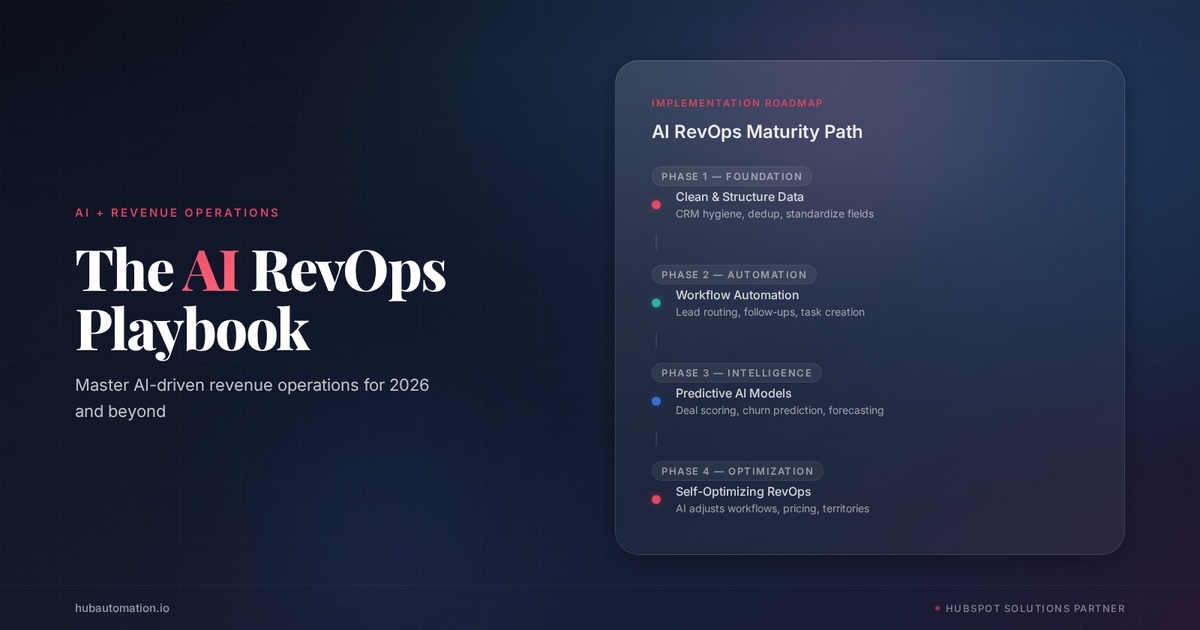
The AI RevOps Maturity Model: Where You Probably Are
We think about AI RevOps implementation in phases. Where does your team fall?
Phase 1: Experimental (Most Teams Here)
You're testing AI tools. You might have HubSpot's AI features enabled, or you're using ChatGPT for content, or you're thinking about predictive scoring. You're not fully committed, and you're not sure what value it'll drive. That's fine. Phase 1 is exploration.
Phase 2: Strategic Deployment (Some Teams Here)
You've identified specific problems AI can solve, you've cleaned your data to support those use cases, and you're implementing tools systematically. Maybe you've deployed predictive lead scoring, and you've trained your team on how to use it. Maybe you've implemented AI content generation for your nurture campaigns. You're seeing real results.
Phase 3: Full Integration (Very Few Teams Here)
AI is woven through your entire RevOps process. Scoring is predictive. Content is AI-assisted. Routing is algorithmic. Forecasting is data-driven. Your workflows and automations leverage AI at multiple touchpoints. Your team has adapted to this new reality. That's mature AI RevOps.
Most teams are somewhere between Phase 1 and Phase 2. And honestly, that's fine. The goal isn't to implement every AI tool, it's to systematically think about where AI can add value, implement those use cases with discipline, and iterate.
The 2026 RevOps Playbook: How to Approach This Right
So if we were rebuilding a RevOps function from scratch in 2026, with AI available, what would we do?
Step One: Clarify Your Strategy (Weeks 1-4)
Before touching any tools, get crystal clear on your revenue model, your ideal customer profile, your sales process, and your metrics. This doesn't change because of AI. Do this right, and everything else gets easier.
Step Two: Clean Your Data (Weeks 4-8)
Before implementing any AI tools, clean your data. Deduplicate contacts. Complete missing company information manually if needed. Clarify your pipeline stages and make sure they're being used consistently. This is unsexy work. That said, it's foundational and you can't skip it.
Step Three: Build Your Pipeline and Automation Foundation (Weeks 8-12)
Create your sales process stages, define required properties at each stage, and build automation that enforces discipline. This is the infrastructure that everything else runs on. Again, this is not new, we've been saying this for years. AI just makes it more important because it amplifies the value of good process.
Step Four: Layer AI Into Your Existing Process (Weeks 12-16)
Now that you have strategy, clean data, and good process, add AI tools where they solve specific problems. Maybe you add predictive lead scoring. Maybe you add AI content generation. Maybe you add smarter routing. Pick the highest-impact use case and execute it fully before moving to the next one.
Step Five: Measure and Optimize (Ongoing)
Not every AI tool will work for your team. Some will be game-changers. Some will be meh. Measure impact. Double down on what works. Shut down what doesn't. And honestly, do this quarterly because the tools are improving fast and your use cases will evolve.
The Real Opportunity
Here's what we actually believe about AI and RevOps: AI is going to make great RevOps teams absolutely unstoppable. Companies with clear strategy, clean data, good process, and strategic AI deployment will outperform everyone else. But AI won't save broken RevOps. A broken team with AI tools is just a broken team with prettier reports.
The real opportunity isn't the AI. It's that AI gives you leverage to do better RevOps. And if you've already done the hard work of good RevOps, AI tools are the multiplier that makes everything amazing.
That said, if you haven't done the foundation work, if your data is still messy, if your process is still inconsistent, if your strategy is still unclear, now is actually the perfect time to fix those things. Because once you fix them, AI tools make them shine. And honestly, that's the playbook we're betting on.
Ready to think about AI RevOps strategically? We offer a complimentary RevOps Assessment that reviews your current strategy, data quality, process, and identifies where AI tools can create the most impact. Most teams find 3-5 major opportunities. Let's talk about your 2026 RevOps roadmap.
The Bottom Line
AI is genuinely transformative for RevOps teams. It changes scoring, enrichment, content generation, routing, and forecasting. But it doesn't change the fundamentals: you still need strategy, you still need clean data, you still need good process, you still need human judgment, and you still need discipline. And honestly, that's good for us because it means the companies that do RevOps well are going to crush it in 2026, and the companies that don't do RevOps well are just going to be well-organized at being chaotic. We like the winners. And we want you to be one of them.
HubAutomation is a Certified HubSpot Solutions Partner. We help companies approach AI RevOps strategically, not just as hype, but as a genuine business lever. If you want an honest assessment of your RevOps maturity and where AI fits, let's schedule your complimentary RevOps Assessment.
Want to see where your blind spots are? We run free diagnostics for companies like yours.
Want to see where your CRM is leaking revenue?
We run free 30-minute HubSpot diagnostics. Your portal, on screen, live. You leave with a prioritized fix list, yours to keep whether you hire us or not.
| Book my free 30-min audit |