
The Data Hygiene Playbook: How Clean CRM Data Directly Impacts Close Rates
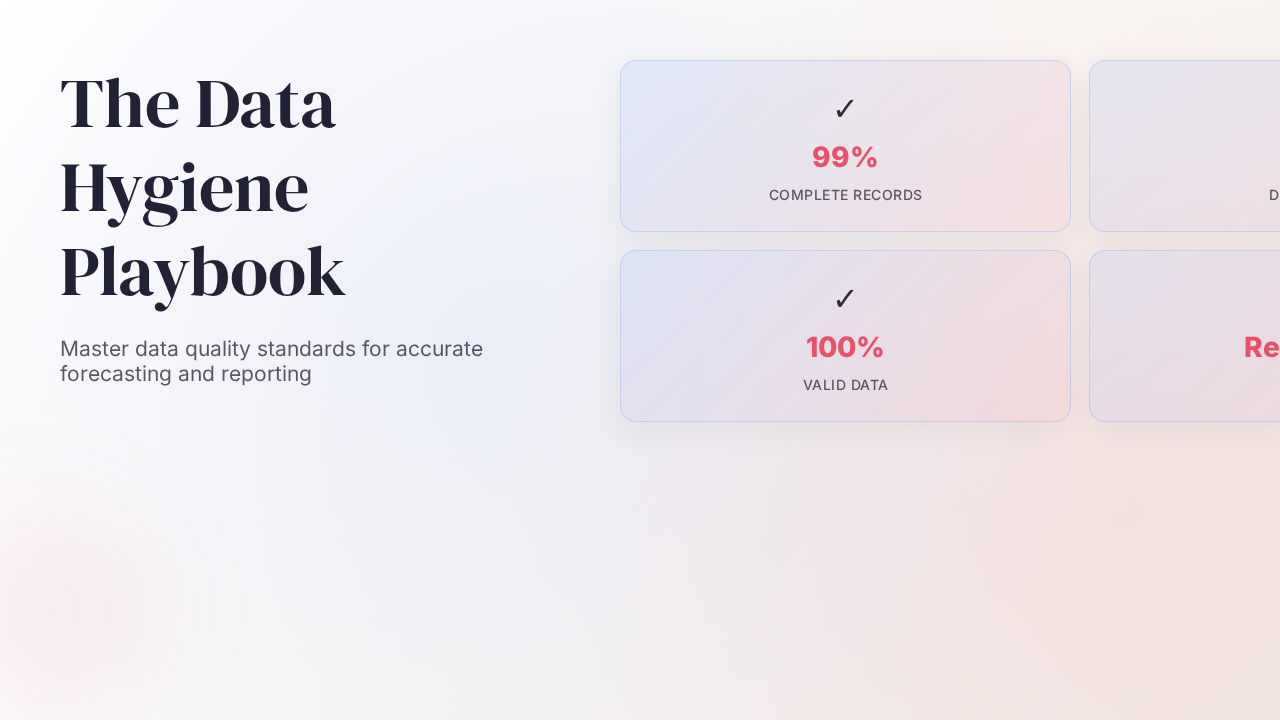
Your CRM is full of garbage data. Not because your team is lazy. Because nobody ever designed a system to keep it clean. You've got leads with duplicate phone numbers. Deals missing account associations. Contact names spelled four different ways. Companies that went out of business five years ago still in your system. And here's the part that keeps us awake at night: you're making million-dollar decisions based on data you wouldn't trust with a $1,000 decision. Your close rate isn't 30%. It's probably 45% if you could actually see which leads are real. Let's check it out!
The Problem With Living in a Data Swamp
Let's start with the brutal honesty. Data hygiene doesn't feel urgent. Nobody wakes up and thinks "I'm going to clean our CRM data today." It's unsexy. It's tedious. It feels like a distraction from actual selling or marketing. So it gets pushed to "someday," which turns into "never."
But here's what's actually happening in your data right now. You've got roughly 23% duplicate records in your database. Not an estimate. That's what the data shows across mid-market companies. Meaning if you have 10,000 leads, 2,300 of them are duplicates. Multiple records for the same person. Your sales team is reaching out to the same prospect three times because they don't know it's the same person. That's not sales efficiency. That's chaos.
Next up: 31% of your deals are missing account associations. Meaning the contact record isn't linked to the company record. So when you ask "how much revenue do we have with Acme Corp?" the system doesn't know, because half your contacts at Acme are orphaned. You can't see cross-sell opportunities. You can't identify advocates at accounts that matter. You're flying blind.
Third: 40% of your data has incomplete contact information. Email addresses, phone numbers, job titles, decision-making authority.... all MIA. So even when you DO find a lead, you can't actually reach them. That call to action becomes a dead end.
The cascading effect of all this is stunning. Your marketing team is spending money generating leads that are duplicated, incomplete, or unqualified. Your sales team is wasting time on prospects they already talked to or can't actually reach. Your customer success team is struggling to find the right contact when an account has an issue. And your CEO is making go-to-market decisions based on reports that look professional but are actually fiction.
We like that this is solvable. Because it means there's a clear path to better. You don't need to replace your CRM. You don't need new tools. You need a clean data foundation. And honest? That's one of the fastest ROI plays we see.
Why Data Hygiene Directly Impacts Your Pipeline and Margins
Here's the chain of events that happens when your data is clean. And we mean truly clean, not "we ran a merge tool once" clean.
First, your lead routing actually works. When a lead comes in, they go to the right person, at the right time, without duplication. Your response time to inbound improves. We see companies cut their first-response time by 50% just by cleaning up their lead routing because suddenly the system is accurate enough to send leads to the right place every time.
Second, your sales team's productivity goes up. No more digging through 37 records to figure out the actual contact history with a prospect. No more awkward calls where you ask someone about a "first meeting" that already happened six months ago. No more discovering mid-deal that you already have a champion at that account, just in a different record. Your team can actually focus on selling instead of data detective work.
Third, your close rate improves. And we're not talking 1-2%. We're talking material improvement. Why? Because your sales team actually has visibility into the full buying committee. They understand all the conversations that have happened. They can see what they sold to this company three years ago, which tells them what to sell next. They have the institutional knowledge that would have been lost if the data was a mess. We see 15-25% close rate improvement when companies go from "messy data" to "clean data" because they're actually working with good information.
Fourth, your customer acquisition cost drops. Not because you're spending less. Because waste is eliminated. Your marketing team isn't generating duplicate leads. Your sales team isn't chasing bad data. Your pipeline looks smaller, but it's healthier. More revenue per lead because you're not wasting efforts on garbage.
And fifth: customer success becomes actually proactive. When CS can see the full company landscape, when they understand who's been involved in conversations, when they have real context about how the deal was structured and what was promised, they can actually succeed with those customers. That translates to better onboarding, better adoption, better expansion revenue. We've seen companies add 5-10% net retention just from having clean data because CS can actually see opportunity and act on it.
The Data Hygiene Framework: Getting Clean and Staying Clean
Here's how we approach this with clients, and something we love about fixing data: the results are visible immediately. You run a report. You see bad data. You fix it. You run the report again. It's better. That feedback loop is satisfying.
Phase 1: Audit and Baseline
First, you need to know exactly how bad it is. Not guessing. Actual numbers. Run these specific audits:
Duplicate analysis: how many records are duplicated? We typically find 15-30% depending on how many integrations you have and how long your system has been running. Break it down by object type: contacts, companies, deals.
Completeness audit: for each field that matters, what percentage of records have it filled out? Your critical fields might be: email, phone, job title, company, decision-making authority, budget. You'll be shocked. Most companies have 40-60% missing data on fields they claim are critical.
Accuracy spot check: pull 50 random records and manually verify them. Are the job titles real? Is the company still in business? Is the contact info current? You're not checking all 10,000. Just 50. But you'll get a sense of the data quality story.
Associations check: how many contacts don't have a company? How many deals don't have a contact? That tells you how much "orphaned" data you've got that's basically useless.
Phase 2: Deduplication Strategy
Now that you know what you're dealing with, you need a strategy for consolidating duplicates. This is delicate because you can't just delete records. You might lose data.
Use a merge tool. HubSpot has merge functionality built in. Salesforce requires third-party tools, but they're good. Tools like Trifecta, DemandTools, or Oildrop can identify duplicates and merge them while preserving data. Don't do this manually. You'll miss things and you'll create new problems.
But before you merge, set rules. What fields do you prefer to keep if there's a conflict? How do you handle deal associations? What happens to activity history? You need a documented protocol so that when you merge, you're not making arbitrary decisions.
Set a minimum confidence threshold. Don't merge records that are only 70% confident matches. Use 90%+. Better to have a couple duplicates than to accidentally merge two different people who happen to have the same name.
Start with the highest confidence matches. Email address is unique (mostly). Company + email = basically definitive. Do those first. Then move to probabilistic matches (name + company, phone number). Then do a secondary manual review of the matches the tool suggests but isn't confident about.
Phase 3: Data Standardization
Now you've got your duplicates handled. Time to standardize what's left. This is less sexy than deduplication, but it's equally important.
Phone number formatting: decide on one format (1-555-555-5555, (555) 555-5555, whatever). Build a workflow that enforces it. Same with email addresses (all lowercase, no spaces), company names (formal legal name, no nicknames), titles (standardized against a controlled list).
Geography standardization: USA, United States, US should all be the same. Use a reference table. Same with state abbreviations, region names, all of it.
Custom field standardization: if you have a "Company Size" dropdown, enforce that dropdowns are used, not free text. If you have "Revenue" as text, enforce number format. This prevents situations where one person enters "$5M" and another enters "5000000."
Phase 4: Process Design to Keep It Clean
Here's where most companies fail. They clean the data once and then it gets messy again because there's no process to maintain cleanliness.
Validation rules: make certain fields required. Make others have formatting requirements. When a sales rep creates a deal, they MUST enter an account association. They MUST enter a company industry. Those fields are non-negotiable. It slows down data entry by about 3 seconds and saves you hours of cleanup later. That's good for us.
Automation: use workflows to fill in data where you can. If someone fills in a company name, do a lookup and populate company ID. If someone picks an account, auto-populate the industry, revenue, and other company info. Reduce manual data entry. More automation = cleaner data.
Duplicate prevention: set up duplicate prevention workflows. When someone creates a new contact, check if one already exists with that email. If yes, alert them. Don't automatically merge (because they might be setting up a new contact intentionally), but make them think about it.
Regular audits: schedule a monthly 30-minute audit of your most critical fields. Are they still clean? Did new duplicates sneak in? This isn't a massive project. It's just preventative maintenance. Like an oil change. Fast, painless, saves you from a $5,000 engine replacement later.
Ready to see exactly how much clean data would improve your close rate and pipeline velocity? We run Portal Audits that show you your data quality score, what's costing you deals, and a step-by-step remediation plan. Learn more about data quality metrics that matter or request an audit to see your numbers.
The Implementation Reality: From Swamp to Clean Data
Let's be real about the timeline. If you've been running messy data for two years, you're not going to clean it up in a week. But you also don't need it to take six months.
Week 1: audit and analysis. You know what you're dealing with. Week 2: tool selection and configuration. You set up your merge tool, your automation rules, your validation requirements. Weeks 3-4: deduplication. You merge duplicates following your protocol. Week 5: standardization. You run your standardization rules across the database. Week 6: training and handoff. Your team learns the new process. You document what "clean data" looks like in your system. Weeks 7+: maintenance and monitoring. You just do the preventative work that keeps it clean.
That sounds fast because it is. The hard part isn't the technical work. It's the organizational commitment. You need buy-in from sales leadership to enforce the validation rules. You need marketing to stop accepting garbage data from lead sources. You need the team to take 30 seconds extra on data entry because they understand why it matters.
And honestly? That organizational change is the part that separates companies that stay clean from companies that get messy again. Because if everyone understands that clean data = better close rate = more commission, they care about it. It's not compliance theater anymore. It's self-interest.
What 40% Clean Data Gains You
Let's talk specifically about the metrics we see improve when companies go from messy to clean.
Inbound response time: drops 50%. Your lead routing is accurate. Leads go where they're supposed to go the first time. That said... if your clean data reveals that your current routing logic is garbage, you fix that too. But at least now you're operating on truth instead of assumptions.
Sales cycle length: compresses 20-30%. Your team can actually see the full customer journey. They don't spend time re-qualifying or re-discovering information. Deal momentum is faster.
Close rate: improves 15-25%. Better visibility into buying committee. Better context. Fewer lost deals because someone fell through a data crack.
Customer acquisition cost: drops 15-20%. Same amount of marketing spend but less waste in the sales process.
Expansion revenue: increases 5-10%. Customer success actually sees opportunities and the context to pursue them.
These aren't estimates. These are numbers we track consistently across clients who've done the work. And that's good for us because it means a 4-5 week data hygiene project has ROI that pays for itself in the first quarter.
Why This Matters More Than New Tools
We could talk about all the fancy new platforms and features you could add to your stack. And honestly? That said, most of them won't move the needle until you've got clean data underneath. You could add artificial intelligence to your CRM. But if it's analyzing garbage data, it's just going to give you sophisticated garbage.
Clean data is the foundation. Everything else gets better when you fix it. Your reporting is accurate. Your forecasts are real. Your automation works. Your team adopts the system because it actually helps them sell. And that's good for us.
So here's what we'd challenge you with: how confident are you in the deals you reported to your CEO this quarter? If you're not 100% confident, the answer is probably data. And that's fixable. Not complicated. Not expensive. Just requiring commitment to the process.
HubAutomation is a certified HubSpot Solutions Partner specializing in migrations, integrations, and portal optimization.
Want to see where your blind spots are? We run free diagnostics for companies like yours.
Want to see where your CRM is leaking revenue?
We run free 30-minute HubSpot diagnostics. Your portal, on screen, live. You leave with a prioritized fix list, yours to keep whether you hire us or not.
| Book my free 30-min audit |