HubSpot AI Tools in 2026: What Actually Works and What's Still Hype
HubSpot AI Tools in 2026: What Actually Works and What's Still Hype
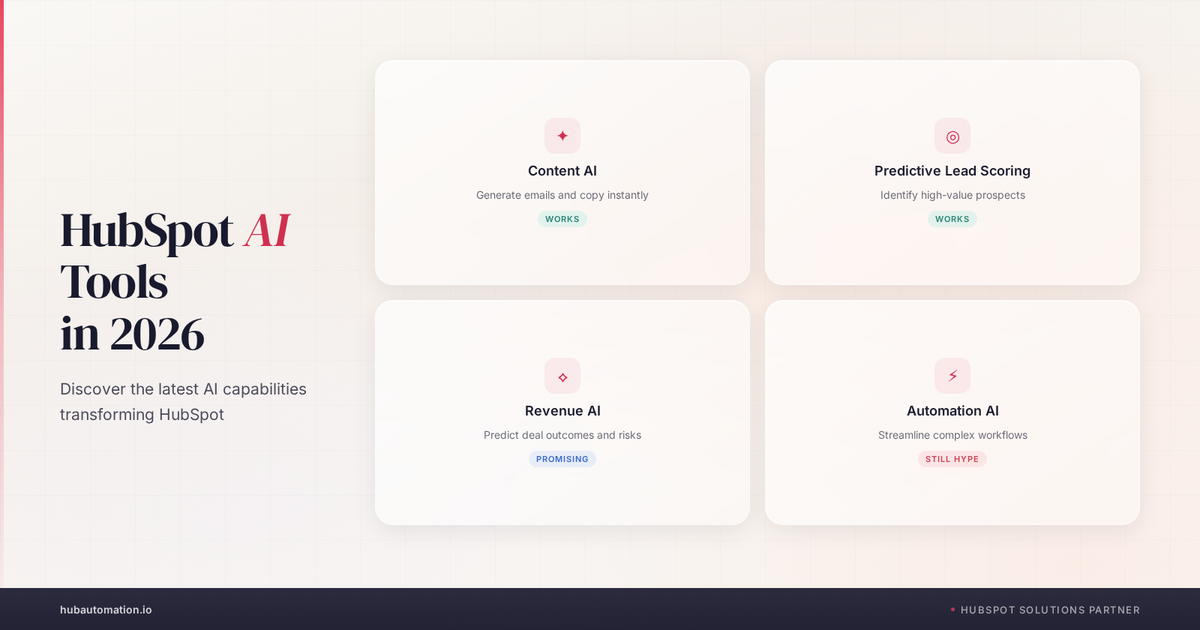
HubSpot launched a bunch of AI tools last year. And we mean a BUNCH. Content Assistant. ChatSpot. Predictive Lead Scoring. AI Deal Forecasting. AI Email Summaries. And more. The question we keep hearing from our clients is simple: "Okay, which of these things actually work?" And honestly, that's the right question because not all of them are at the same maturity level. We like that some of these are legitimately transformative. We also like that we're not shy about telling you which ones aren't ready yet....... Let's check it out.
The HubSpot Content Assistant: Actually Pretty Damn Good
Let's start with the one that's working. The Content Assistant is HubSpot's AI writing tool that lives inside your portal and helps you generate email copy, blog posts, social media content, and landing page text. And honestly? We've been genuinely impressed with what it can do.
What It Actually Does:
You give it a topic, a tone, an audience, and sometimes a quick outline. The AI generates full email sequences, blog outlines, social posts, or webpage copy. You can then edit, refine, or completely rewrite it. It's not perfect, but it's WAY better than a blank page.
Where It Actually Works:
Email sequences. If you need to generate a five-email nurture sequence and you give it good context (audience, pain points, your value prop), it will generate something that's 70-80% there. You spend 15 minutes refining it instead of 90 minutes writing it from scratch. That's a huge time savings. And honestly, the copy quality is solid. Not earth-shattering, but professional and persuasive.
Blog outlines and titles. The AI is genuinely good at suggesting blog post structures and compelling headlines. We've used it to outline posts, then written the actual content ourselves. Saves a huge amount of thinking-through-structure time.
Social media copy variations. You have a core message and need five different Twitter variations? The AI generates solid options in seconds. You might rework one or two, but it's a significant productivity gain.
Where It Struggles:
Highly specialized or technical content. If you're writing about niche industry stuff that requires deep expertise, the AI sometimes misses the nuance. It might be technically correct but positioning-wise off. You have to heavily edit.
Sales email personalization. The AI is good at generating templates, but if you need an email that references a specific customer situation, specific problem they mentioned, or specific competitive context, you have to write that yourself. The personalization layer is still human.
Brand voice consistency. If your brand has a very specific voice (like Stu L's HubAutomation voice, for instance), the AI won't capture it perfectly. You have to guide it heavily. And honestly, we spend a lot of time editing Content Assistant output to match our actual voice. It helps, but it's not a complete replacement for a real writer.
Our Verdict:
The Content Assistant is legitimately useful for productivity. We'd estimate it saves 30-40% of content creation time across an average marketing team. If you're generating a lot of volume content, nurture sequences, social posts, email templates, it's worth having on your team. Just don't expect it to be your content strategy. Pretty sweet tool, honestly.
ChatSpot: The Conversation Interface That's Still Finding Its Place
ChatSpot is HubSpot's conversational AI that lives in Slack and on your HubSpot sidebar. You can ask it questions about your HubSpot data, ask it to generate content, or ask it to help you with various tasks. The promise is that it integrates with your portal and understands your data.
What It Actually Does:
You ask ChatSpot questions like "How many deals are in our Sales Pipeline stage?" or "What's the revenue by industry for Q1?" or "Generate an email to prospects in our tech industry segment." It queries your HubSpot data and gives you answers. Or it generates content based on your request. Or it helps you with various HubSpot tasks.
Where It Actually Works:
Quick data queries that would normally require you to log into HubSpot and build a report. "How many customers closed last month?" ChatSpot will tell you. "What's our average deal size by industry?" It can answer that without you having to open HubSpot Reports. That's convenient.
For people who don't know HubSpot deeply, ChatSpot makes it easier to get answers without having to understand how to navigate the UI or build reports. That's actually valuable for teams with less HubSpot expertise.
Where It Struggles:
Complex queries. Ask ChatSpot a complex question about pipeline momentum or multi-step data logic, and it often gets confused. It might misunderstand what you're asking. It might give you an answer that's technically correct but not what you needed. We like that less.
Data accuracy confidence. With ChatSpot, you don't always know if the answer is right. You have to verify it against your actual HubSpot reports. That defeats some of the purpose, you still have to check your work. And that's a problem.
Conversational context. ChatSpot doesn't really maintain conversation memory the way you'd expect from a true conversational AI. You ask it something, it answers, and then the next question starts kind of fresh. So doing multi-step analysis is clunky.
Our Verdict:
ChatSpot is useful for quick queries and for people who aren't comfortable with HubSpot reporting. If your team is analytics-savvy, you probably won't use it much. It's a nice-to-have productivity tool, not a game-changer. And honestly, the data accuracy concerns keep us from fully trusting it with important decisions.
Predictive Lead Scoring: This One Actually Works (When Your Data is Clean)
HubSpot's Predictive Lead Scoring uses machine learning to identify which leads are most likely to convert into customers. It analyzes your historical customer data and identifies patterns that predict sales-readiness. And we like this one because it actually works, but with a big caveat.
What It Actually Does:
The tool looks at your historical contacts that became customers versus those that didn't. It identifies patterns in their properties, behaviors, and engagement, company size, industry, email engagement, page views, content downloads, etc. Then it applies those patterns to your current leads and gives each lead a score from 0-100 indicating likelihood to become a customer.
Where It Actually Works:
If you have clean data and a decent volume of historical conversions, predictive scoring is genuinely valuable. We've seen lead scoring models that improved sales efficiency by 15-20%. Sales reps focus on leads with 70+ scores, and those leads are dramatically more likely to close than leads with 40 scores.
The beauty of predictive scoring is that it's data-driven rather than guessed. Some sales managers say "Focus on tech companies with 100+ employees" but that's gut feel. Predictive scoring says "These characteristics predict conversion with 78% accuracy." And honestly, that's better.
It also evolves. As you close more customers, the model learns and improves. Your scoring model in month six is more accurate than month one.
Where It Struggles (And This Is Critical):
Bad data breaks the model completely. If your database is full of duplicates, if company size property is incomplete for 40% of contacts, if engagement data is unreliable, the model will be garbage. Garbage in, garbage out. We see this a lot.
Low conversion volume. If you're a new company that has only closed 50 customers, the model doesn't have enough data to learn meaningful patterns. You need at least a few hundred customer conversions to have a reliable model.
Changing customer profile. If your ideal customer profile changed significantly between your early customers and your current customers, the model gets confused. It optimizes for your old customer type, which might not be your strategy anymore.
Our Verdict:
Predictive Lead Scoring is legitimately powerful IF you have clean data and sufficient conversion history. If you don't, it's actually worse than manual scoring because it gives false confidence to a bad model. We recommend: Clean your data first. Make sure you have 200+ historical customers. Then enable predictive scoring. When done right, it's a real revenue driver. And that's good for us.
AI Deal Forecasting: Great Concept, Still Buggy Execution
HubSpot launched AI-powered deal forecasting that's supposed to predict which deals are most likely to close based on deal properties, deal progression, and historical patterns. Sounds amazing. And the concept is solid. But the execution is still rough.
What It's Supposed to Do:
The AI looks at your deals and identifies which ones are most likely to close. It analyzes patterns from your closed deals and identifies similar characteristics in your open deals. Then it predicts closure probability and timing.
Where It Works Okay:
If your pipeline is very standardized and your reps consistently move deals through stages the same way, the model can identify some real patterns. Deals that stall for more than 30 days in a stage are less likely to close, that's stuff the model can learn and surface.
The concept of "these deals look like your historical winners" is valuable for coaching reps on which deals to prioritize.
Where It Absolutely Fails:
Stage inconsistency is killer. If your reps use stages differently (some use them religiously, others barely move deals), the model can't learn anything. It's trying to find patterns in noise.
The model is heavily stage-driven, which means if your pipeline stages aren't reflective of actual deal probability (which we talked about earlier), the forecasts are wrong. Garbage in, garbage out again.
Deal velocity matters, but the model sometimes misweights it. A deal that's been in Solution Design for 45 days might look stuck, or it might be a big complex deal that just takes time. The AI doesn't always understand context.
Our Verdict:
AI Deal Forecasting is not ready for primary forecasting decisions yet. It's a supplementary view at best. We like the direction, but the accuracy isn't there. In another year? Probably much better. For now, the human-driven weighted forecasting framework we talked about in our pipeline post is more reliable.
AI Email Summaries: Honestly Pretty Useful
This is a quiet one that doesn't get as much hype but is genuinely useful. When a contact emails you multiple times, HubSpot's AI can generate a summary of the email thread so you quickly understand what's going on without reading all five emails.
What It Does:
You open a contact record, you see there's an email thread with five exchanges. The AI generates a short summary: "Contact asked about implementation timeline, we said 60 days, they said they need it in 30, we offered accelerated onboarding, they accepted."
Where It Works:
Long email threads where you're trying to catch up quickly. Multi-week back-and-forth where you don't have context. It's a real time-saver. And honestly, it's usually accurate because email summaries are lower-risk, you're just condensing information, not making predictions.
Where It's Mediocre:
Complex technical discussions where nuance matters. And tone, it sometimes misses when a customer is frustrated versus just asking a question. But for getting the gist, it works.
Our Verdict:
Actually useful. Turn it on. It's a real productivity gain with minimal downside.
The Pattern: AI Is Great at Augmentation, Still Weak at Prediction
Looking across all these tools, there's a clear pattern. HubSpot's AI is genuinely useful for augmentation, writing content, summarizing information, generating copy, querying data. It's actually pretty weak at prediction, forecasting which deals will close, which leads will convert. Prediction requires clean data, consistent behavior, and sufficient historical examples. And most companies don't have those fundamentals nailed down yet.
That said, HubSpot's AI tools are improving monthly. The versions we tested in January are better than October. This is very much a "come back next year, it'll be better" situation for the prediction tools.
And honestly, the real opportunity isn't whether these AI tools are perfect. It's whether your team has the discipline to use them right. We like that.
Want to know which AI tools are right for your portal? We offer a complimentary Portal Audit that includes a review of which HubSpot AI tools would add the most value to your team, what data cleanup might be needed to make them work, and how to implement them properly. Let's talk about your AI strategy.
The Bottom Line
HubSpot's AI tools are legitimately useful, but they're not all at the same maturity level. Content Assistant is production-ready and genuinely valuable. Predictive Lead Scoring works if your data is clean. AI Deal Forecasting is interesting but not reliable yet. ChatSpot is nice-to-have. And Email Summaries are actually pretty sweet. The key is being honest about which ones are ready for prime time and which ones are still developing. And honestly, that's what we love about being deep in the HubSpot ecosystem, we get to see what actually works and help our clients avoid the hype.
HubAutomation is a Certified HubSpot Solutions Partner. We help companies implement AI tools in HubSpot strategically, not just because they're new. If you want an honest assessment of what AI tools make sense for your team, let's talk.
Want to see where your blind spots are? We run free diagnostics for companies like yours.
Want to see where your CRM is leaking revenue?
We run free 30-minute HubSpot diagnostics. Your portal, on screen, live. You leave with a prioritized fix list, yours to keep whether you hire us or not.
| Book my free 30-min audit |