
The RevOps Maturity Model: Where Does Your Company Sit?
The RevOps Maturity Model: Where Does Your Company Sit?
How mature is your revenue operations function, really? Most companies ask us this question and then squirm a little when we dig into the details. Because here's the thing. We've worked with hundreds of HubSpot customers, and we can tell you that the vast majority are operating at one of the earlier stages of RevOps maturity. And that's okay! It's not a judgment. It's actually the starting point for something better.
The RevOps Maturity Model gives us a framework to understand where we are and, more importantly, where we can go. Let's check it out!
Why RevOps Maturity Matters (And What We Mean By It)
Before we walk through the five levels, let's define what we're talking about. RevOps maturity isn't about having fancy features enabled in HubSpot. It's about alignment, process, and intentionality across your revenue-generating teams. It's about whether your sales, marketing, and customer success functions are actually working FROM the same playbook, using the same data, and optimizing toward shared goals.
Here's what we've observed: companies that understand their maturity level make faster progress. They don't try to skip steps. They don't expect a playbook strategy when they're still in reactive firefighting mode. And they certainly don't blame HubSpot for problems that are actually operational silos. When you know your level, you can build the right strategy to move to the next one. And that's good for us. Because revenue operations done right? It compounds.
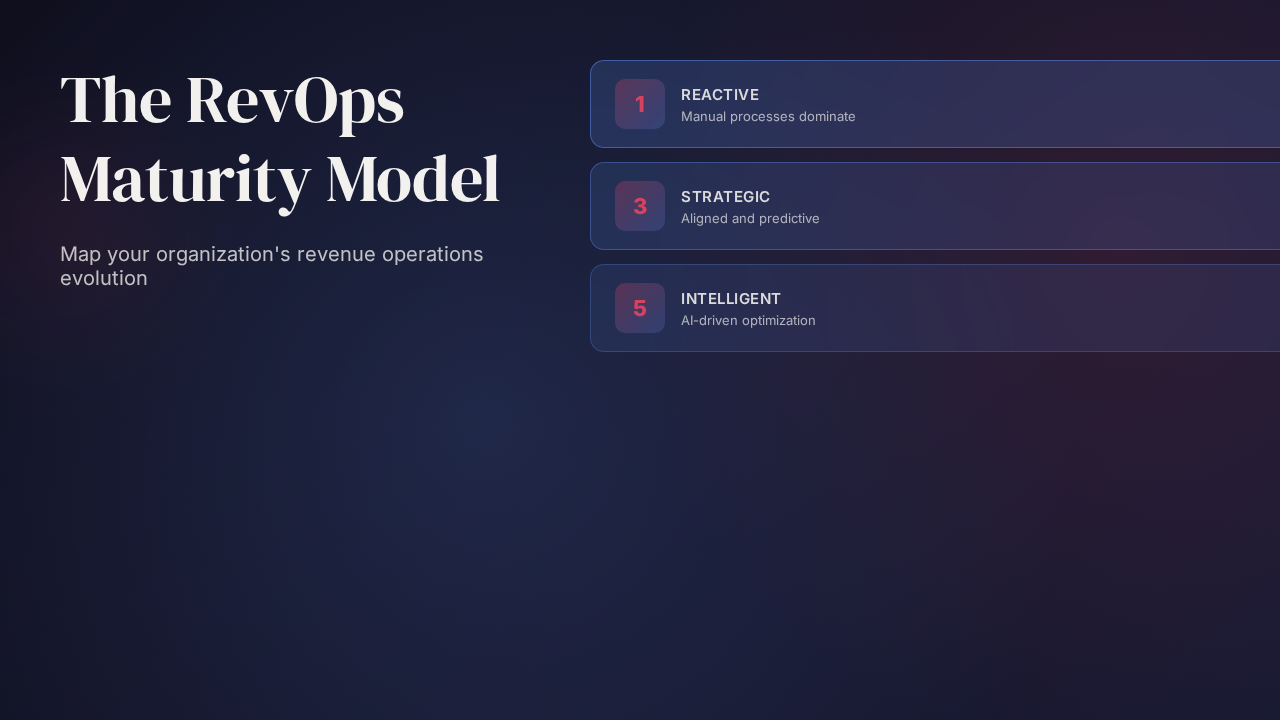
The model we're about to walk through has five levels: Reactive, Defined, Managed, Optimized, and Transformative. Each level builds on the one before it. Each requires mastery of specific practices. And each unlocks new capability in your revenue engine. Let's break them down.
Level 1: Reactive. Putting Out Today's Fire
Welcome to Level 1. If your company is here, don't be surprised. Most are when they first take a hard look at their RevOps function. At this level, your operations are largely REACTIVE. You're handling requests as they come in. Your sales team needs a report? You build it. Marketing wants to know how their campaigns are converting? You query the data manually. Your executives ask three different questions and get three different answers? Yeah, that happens a lot.
What does Level 1 look like in practice? Your CRM is implemented, but it's not really the source of truth for how business gets done. People are still tracking deals in spreadsheets. Sales reps log activity inconsistently because there's no real enforcement mechanism. Your reporting is ad hoc. Dashboards exist, but they're built on request and nobody really maintains them. There's no documented playbook for how deals should move through your pipeline. And when a problem comes up (quota isn't tracking correctly, forecasting is off, territories need realignment), you're solving it in isolation, not against a larger framework.
The operational budget at Level 1 is mostly spent on firefighting. You're busy. Too busy, actually. And because you're busy reacting, you don't have time to think strategically about whether you're optimizing the RIGHT things. You might have HubSpot fully licensed, but you're using maybe 30% of its actual capability because you haven't thought through how each tool should connect to your process.
Here's the good news: Level 1 is also where most of the easy wins live. Once you start thinking about your RevOps as a SYSTEM rather than a series of requests, you move quickly. And that momentum is something we love.
Level 2: Defined. Creating the Playbook
At Level 2, you're starting to build structure. This is where you create DOCUMENTED processes. You have a sales playbook. You've defined what a qualified lead looks like. You've established how deals should move through the pipeline and what activities MUST be logged at each stage. You've started thinking about role alignment, who owns what in the go-to-market function? And you've communicated these things to your teams.
What's different from Level 1? Your team knows THE STANDARD. It's not perfect adherence yet, but everyone understands what "good" looks like. Your reporting is more systematic. You've identified the KPIs that actually matter and you're tracking them consistently. You have dashboard governance. You're starting to think about data quality as an operational priority, not an afterthought. And when something breaks, you're fixing it using a documented process rather than a one-off hack.
At Level 2, you're also starting to see the first benefits of alignment. Sales and Marketing have agreed on what constitutes a qualified lead, and you're measuring against that definition. Customer Success has chimed in on what actually matters for retention, and it's shaping your sales process. You're having better conversations because you're working from shared definitions.
The challenge at Level 2? Execution and consistency. You've documented the playbook, but not everyone is following it yet. Your sales rep in the Chicago office is logging activities differently than your Boston team. Some deals are getting properly scored in HubSpot, others are flying in under the radar. You have DEFINED the process, but you haven't yet ENFORCED it at scale.
That said... Level 2 companies that are serious about moving up start applying some pressure here. They add validation rules to HubSpot. They create consequences for not following the playbook. And they start seeing real data integrity improvements. Something we love about this stage is that the investment is relatively small. You're mostly using HubSpot's native tools to create accountability. Pretty sweet.
Level 3: Managed. Enforcing at Scale
You're at Level 3 when your processes aren't just documented. They're ENFORCED. Your HubSpot instance has validation rules. Your workflow automations are handling data hygiene. Your dashboards are trusted by your executives because you know the data is clean. And here's the thing that separates Level 3 from Level 2: most of your team is following the playbook, most of the time.
What does enforcement actually mean? In HubSpot, it means your deal stage progression has logic behind it. You can't close a deal without updating the close reason. You can't move a deal backward without documented approval. Activity logging is mostly consistent because you've set up workflows that auto-create tasks, auto-log calls, and auto-associate activities to the right records. Your pipeline is predictable because you're actively managing it, not just reporting on it after the fact.
At Level 3, you start doing PREDICTIVE things. Your forecast is accurate because your team is following the process and your data is clean. When you project revenue for next quarter, you're confident. Your sales managers can see which deals are at risk because you've created early warning systems. Your marketing team can see which campaigns are actually generating pipeline, not just leads, but REAL pipeline that converts. And your customer success team knows which customers need extra attention based on engagement metrics that flow from the CRM.
The operational structure at Level 3 is maturing too. You might have a formal RevOps role now. Someone whose primary job is maintaining this system. You have regular cadences for reviewing metrics. You're running pipeline reviews that are actually about pipeline health, not just deal status updates. You're starting to see the revenue engine work as designed.
And honestly, Level 3 is where we see companies start to show measurable impact. Forecast accuracy goes up. Sales cycle shortens. Deal win rates improve. Not because you changed your product or suddenly got a better sales team, but because your PROCESS is working. And that's good for us.
Level 4: Optimized. Continuous Improvement
Here's where it gets interesting. At Level 4, you're not just maintaining your processes. You're actively OPTIMIZING them. You have a structured methodology for testing and improving. You're running A/B tests on your sales playbooks. You're measuring the impact of process changes. You're allocating resources to the highest-leverage activities because you have the data to know which ones they are.
What does optimization look like in practice? Your team is using advanced HubSpot features that most companies haven't even discovered. You're using sequences intelligently, not just as email tools, but as part of a sophisticated workflow that moves prospects through your sales process based on their behavior. You have deal automation that's sophisticated enough to handle your actual business logic. Your reporting is predictive. You're not just looking at what happened, you're forecasting what's GOING to happen and adjusting course.
At Level 4, you're also thinking about the intersection of RevOps and GTM strategy. You're not just maintaining the engine. You're upgrading it. You're testing new sales methodologies. You're experimenting with different territory models or compensation structures, and you're measuring the impact. You're making DATA-DRIVEN decisions about territory alignment, sales team structure, and go-to-market strategy. Your RevOps function is truly strategic, not just operational.
Something we love about Level 4 companies: they're thinking about the customer experience holistically. They understand that RevOps isn't just about sales efficiency. It's about creating a journey that actually works for customers. So they're integrating customer success data back into the sales process. They're measuring customer health and quality of revenue, not just velocity. They're optimizing for LIFETIME VALUE, not just quarterly bookings.
The challenge at Level 4? Avoiding shiny object syndrome. There are ALWAYS new features in HubSpot to try, new data sources to integrate, new metrics to track. Level 4 companies stay disciplined about which optimizations actually move the needle. They have a clear hypothesis before they experiment. They measure impact against their strategic priorities. They don't optimize for the sake of optimization.
Level 5: Transformative. Building the Future
Level 5 is rare. Really rare. At this level, your RevOps function isn't just operating the system. It's TRANSFORMING the business. You're using data and process to fundamentally reshape how your company competes. You're moving beyond incremental improvement into real innovation.
What does transformation look like? These are companies using advanced analytics and machine learning within HubSpot and integrated tools to predict customer churn with such precision that they're preventing revenue loss at scale. They're using behavioral data and AI-assisted insights to create hyper-personalized sales experiences that outcompete traditional methods. They're integrating RevOps data with financial systems so comprehensively that revenue recognition and revenue visibility are essentially synchronized.
Level 5 companies are also typically ahead of industry trends. When the market shifts, they shift faster because their RevOps function is feeding early warning signals directly into strategy. They're experimenting with new GTM models while others are still perfecting the old ones. They're not just following best practices. They're CREATING them.
Here's what's interesting: Level 5 isn't the destination. It's a commitment to continuous transformation. These companies accept that the market will change, their business will evolve, and their processes need to evolve with them. So they build RevOps teams and systems that are designed for change, not resistance to change. And that's the real sophistication.
Where Are You? A Self-Assessment Framework
So how do you know which level your company is at? Here's a quick assessment. Read through these criteria and be honest about where you land.
Level 1 (Reactive): Your CRM is partially populated. Reports are built on request. Sales reps log activity inconsistently. There's no documented sales process. Forecast accuracy is low. You're spending most of your RevOps time answering tactical questions.
Level 2 (Defined): You have documented processes. Deal stages are defined. You know your KPIs. You have regular dashboards. Sales and Marketing are talking about lead quality. Your team understands the playbook, even if they're not all following it yet.
Level 3 (Managed): Processes are enforced through HubSpot configurations. Most of your team follows the playbook most of the time. Forecast accuracy is solid. Your dashboards are trusted. You have someone focused full-time on RevOps. Pipeline reviews are regular and productive.
Level 4 (Optimized): You're running experiments and measuring impact. Your HubSpot instance is sophisticated and customized. You're using advanced features. Your RevOps function is strategic, not just tactical. You're measuring quality of revenue, not just velocity. You have clear hypotheses driving your optimizations.
Level 5 (Transformative): You're ahead of industry trends. RevOps is driving business strategy. You're using AI and advanced analytics. You're experimenting with new GTM models. Your system is designed for continuous evolution.
Which one sounds like you?
The Movement Is The Point
Here's what we know: companies don't need to be at Level 5 to be successful. But companies that understand their level and have a clear path to the next one? They're the ones we see making real progress. Because maturity in RevOps isn't about perfection. It's about intentionality, structure, and continuous improvement. Let's check it out by running a quick RevOps assessment!
Not sure where you sit on the maturity model? Our RevOps Assessment takes a hard look at your current state, identifies gaps, and shows you exactly what your next level looks like. Let's get clear on your starting point so we can build a credible path forward. Schedule your assessment, it takes 30 minutes and costs you nothing.
The RevOps Maturity Model isn't a judgment. It's a roadmap. Wherever you are right now, there's a clear set of improvements that will move you to the next level. And honestly, that's exciting. Because as we move up these levels, the impact compounds. Early stages solve for chaos. Middle stages solve for efficiency. Later stages solve for innovation. And innovation is where real competitive advantage lives.
We're HubAutomation, a certified HubSpot Solutions Partner. We work with companies across all five levels of this maturity model. We help you understand where you are, where you want to go, and exactly how to get there using HubSpot as your platform. Let's build something better together.
Want to see where your blind spots are? We run free diagnostics for companies like yours.
Want to see where your CRM is leaking revenue?
We run free 30-minute HubSpot diagnostics. Your portal, on screen, live. You leave with a prioritized fix list, yours to keep whether you hire us or not.
| Book my free 30-min audit |