Sequences, Workflows, and Playbooks: Which One Does Your Sales Team Actually Need?
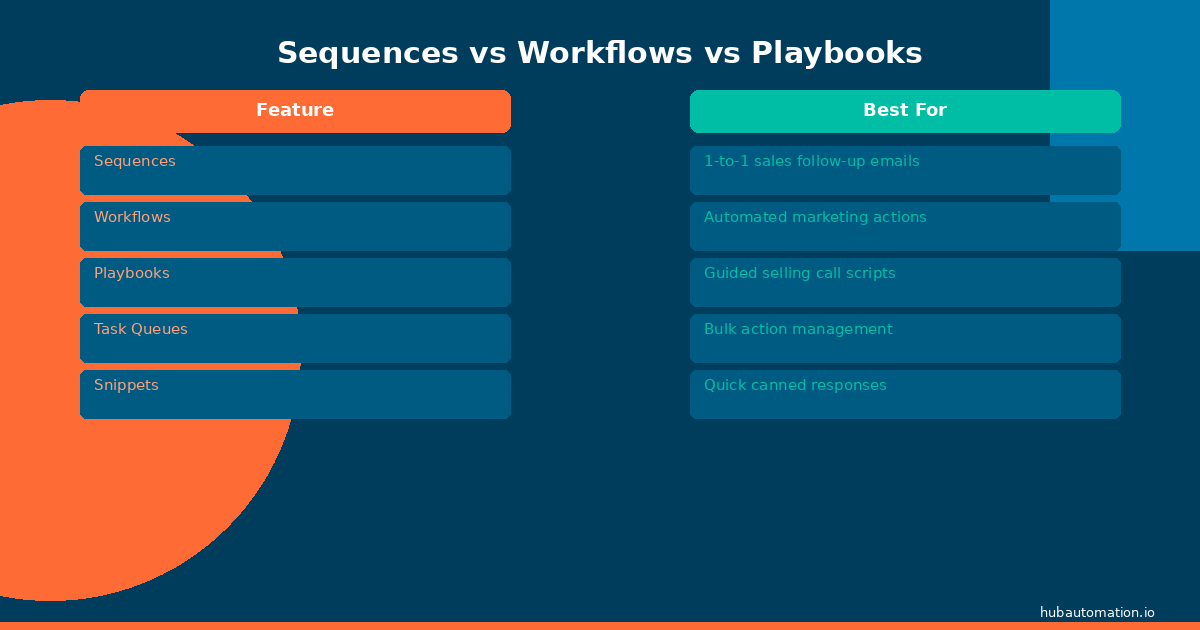
Here's the question that comes up in almost every sales team conversation: what's the difference between a Sequence and a Workflow and a Playbook? Aren't they all just... automating stuff? And when should we use each one? The answer is: nope, they're totally different. A Sequence is a one-to-one sales tool. A Workflow is an automated marketing machine. A Playbook is a guided selling framework. And most teams are using the wrong one for what they're trying to accomplish. We're going to break down each one, show you what they're actually for, and then show you the common mistakes we see. Let's check it out!
The Confusion: Why Teams Get This Wrong
Here's what happens. A sales team gets into HubSpot and they see three tools that all seem like they do vaguely similar things. And they pick one. It's usually the one they've heard about or the one that looks easiest to set up. And then they wonder why it's not working the way they expected.
Someone will say: "We want to automate our follow-ups. Should we use a Workflow?" And the answer is: maybe? But probably not the way you're thinking about it. Workflows are powerful, but they're designed for a different use case than personal sales follow-ups.
Someone else will say: "We want to create a playbook for our sales reps so they know what to do after a discovery call." And they'll try to build it in Sequences. And it won't quite work because Sequences aren't designed for that.
And someone will say: "We want to create an automated email sequence." And they'll use Playbooks. Which is wrong because Playbooks aren't about automation, they're about guidance.
The confusion usually comes because these tools overlap a little bit. They can all send emails. They can all move deals. They can all create tasks. But they're built for different purposes. And if you're using the wrong tool, you're going to get suboptimal results.
So let's break down what each one actually is. What it's actually for. When to use it. And when NOT to use it.
Sequences: The One-to-One Sales Tool
Let's start simple. A Sequence is a sales rep tool. It's designed to let a single sales rep follow up with a single prospect consistently.
Think about what happens in sales: you meet someone at a conference. You send them an email. They don't respond. You send a follow-up. Still nothing. You call them. No answer. You send another email from a different angle. Still nothing. Maybe you try once more and then you give up.
Without a Sequence, you're tracking this in your head (or your notebook, or your personal task list). With a Sequence, HubSpot is tracking it for you. And it's timing your follow-ups so you're not sending them all at once and then forgetting about it.
A Sequence is typically: email, wait a few days, email, wait a few days, call task, wait a few days, email. And it's automated so the sales rep doesn't have to remember to follow up. The system reminds them when it's time to take the next step.
Here's what we love about Sequences: they're personal. They're one-to-one. They usually require a human action (a call, or a personalized email that's not truly automated). And they're tracked so you can see: did this person respond? Did they open the email? Did they click a link?
The magic of Sequences is the consistency. We've seen sales reps who enroll hundreds of prospects in Sequences and see a 35-40% response rate just because they're following up consistently. Most salespeople don't follow up past the first email because they're scared of bothering someone. Sequences remove that fear. The system is following up, not the rep.
Who owns Sequences? Usually the sales rep. They create a Sequence, they enroll prospects, they execute on it. The manager might review it and coach on messaging. But the rep is the one driving it.
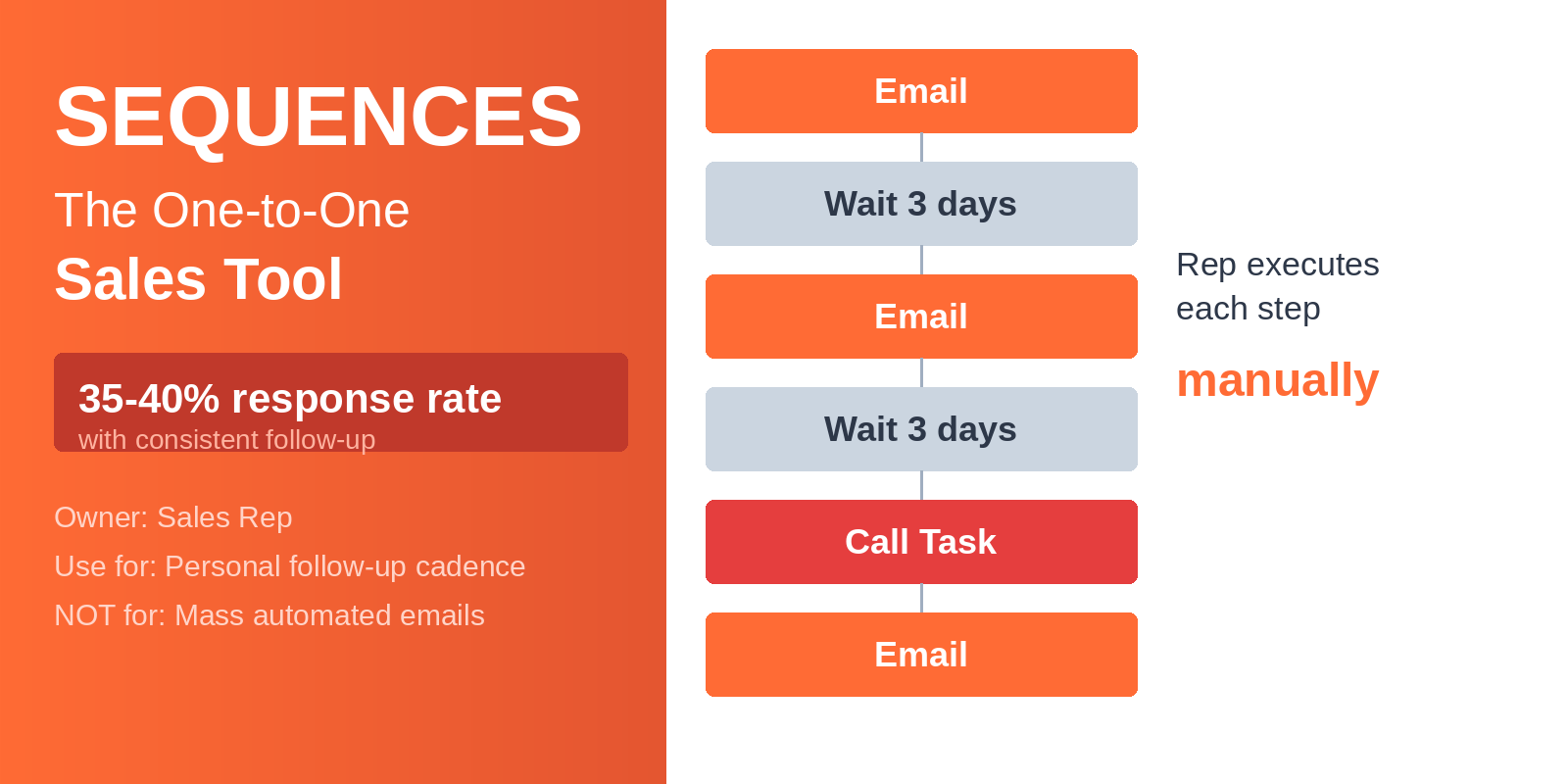
When should you use a Sequence? When you want a sales rep to execute a consistent, personal follow-up cadence with a prospect. When you want the system to remind the rep what to do next. When you want to see response rates and engagement metrics from that prospect.
When should you NOT use a Sequence? When you want completely automated emails with no human touch. When you're trying to nurture a large group of people who aren't ready for sales yet. When your follow-up depends on complex conditional logic. In those cases, keep reading.
Workflows: The Automated Marketing Machine
Okay, so Sequences are one-to-one and personal. Workflows are the opposite: they're many-to-many and automated.
A Workflow is triggered by a condition. Then it executes a series of actions automatically based on other conditions. And it can enroll unlimited people.
For example: When someone fills out a form on your website AND they match your ideal customer profile, enroll them in a Workflow that sends them a series of automated emails, waits three days, sends another email, waits five days, checks if they've opened the email, and if they haven't, sends a different email.
See the difference from a Sequence? A Sequence is: a rep is manually executing this for one person. A Workflow is: the system is executing this for thousands of people automatically based on rules.
Workflows are where marketing automation lives. When you want to nurture a large group of prospects who aren't quite ready for sales, you use a Workflow. When you want to send an automated email to everyone who downloads an ebook, you use a Workflow. When you want to create a lead nurturing campaign, you use a Workflow.
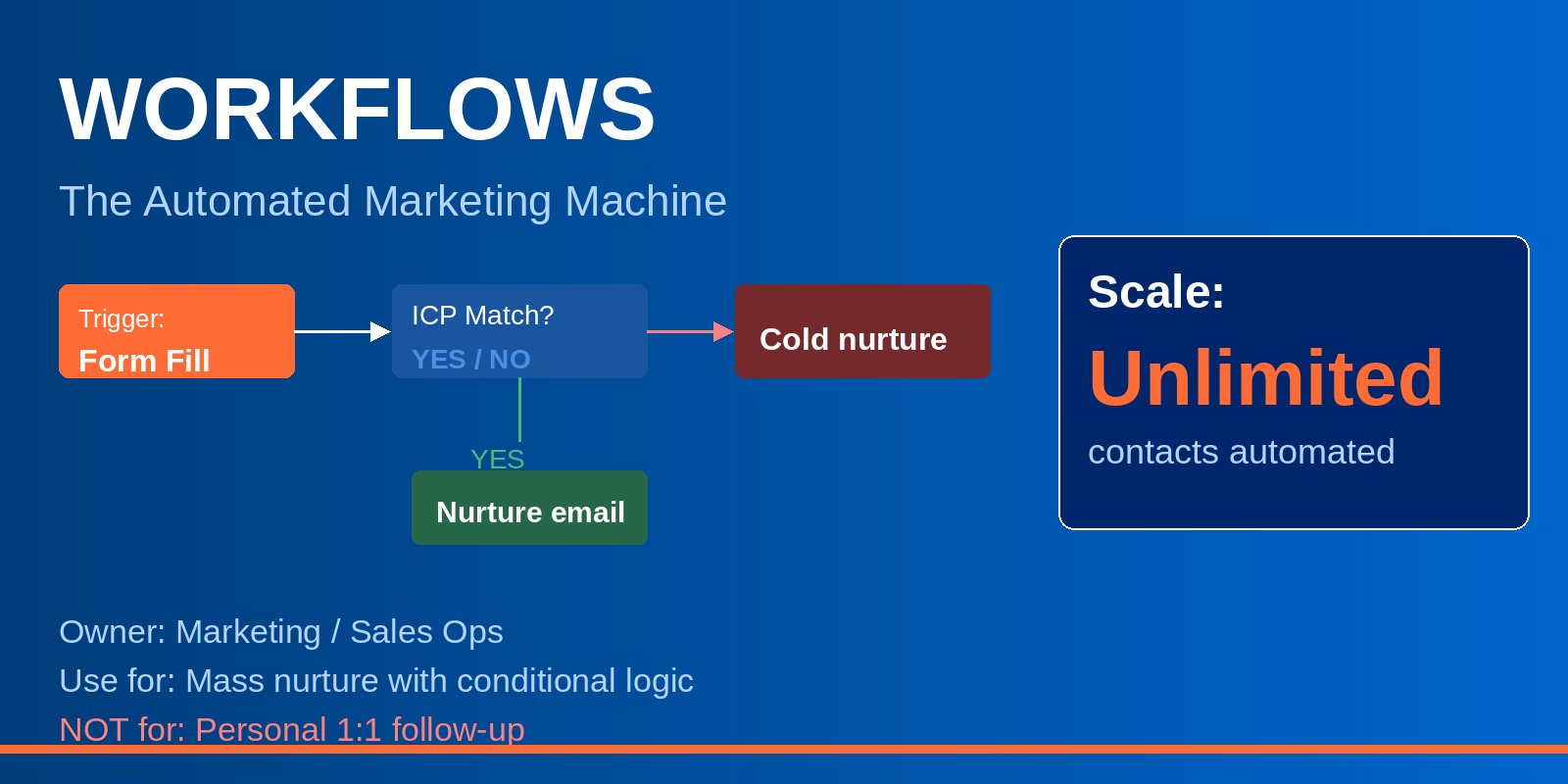
Here's the key: Workflows don't usually have manual actions. They're all automated. And they can be VERY complex. You can set up conditional branching so that if someone opens an email, they go down one path. If they don't open it, they go down another path. If they click a link, they go down a third path.
Who owns Workflows? Usually marketing. Or sometimes sales ops if you're running sales-focused workflows. But a Workflow is a system that runs without human intervention.
When should you use a Workflow? When you want to automate actions for a large group of people based on conditions. When you want conditional branching. When you want the system to make decisions automatically. When you're nurturing people who aren't yet ready for sales.
When should you NOT use a Workflow? When you need personal touches. When you need a rep to make a judgment call (like "should I call this person or email them?"). When you're following up one-to-one with someone who's been engaged. In those cases, use a Sequence.
Playbooks: The Guided Selling Framework
Okay, this is the one people get confused about. Because Playbooks aren't really about automation at all. Playbooks are about guidance.
A Playbook is: here's a recommended series of steps that your rep should take. Here's what you should do next. Here's what to say. Here's what to look for. Here's the usual objections and how to handle them.
A Playbook lives inside HubSpot. It shows up on a deal record. When a deal is in a certain stage, the rep can look at that stage and see: "Okay, here's what I should be doing now." And the system guides them through it.
For example: when a deal is in the "Demo" stage, the Playbook might say: "Your goal is to demonstrate three key features: feature A, feature B, and feature C. Bring up the competitor comparison so they understand our differentiation. Get a commitment for next steps before you end the call." And maybe it includes: sample email templates, objection handling guides, battle cards, recorded demo videos to review before you go in.
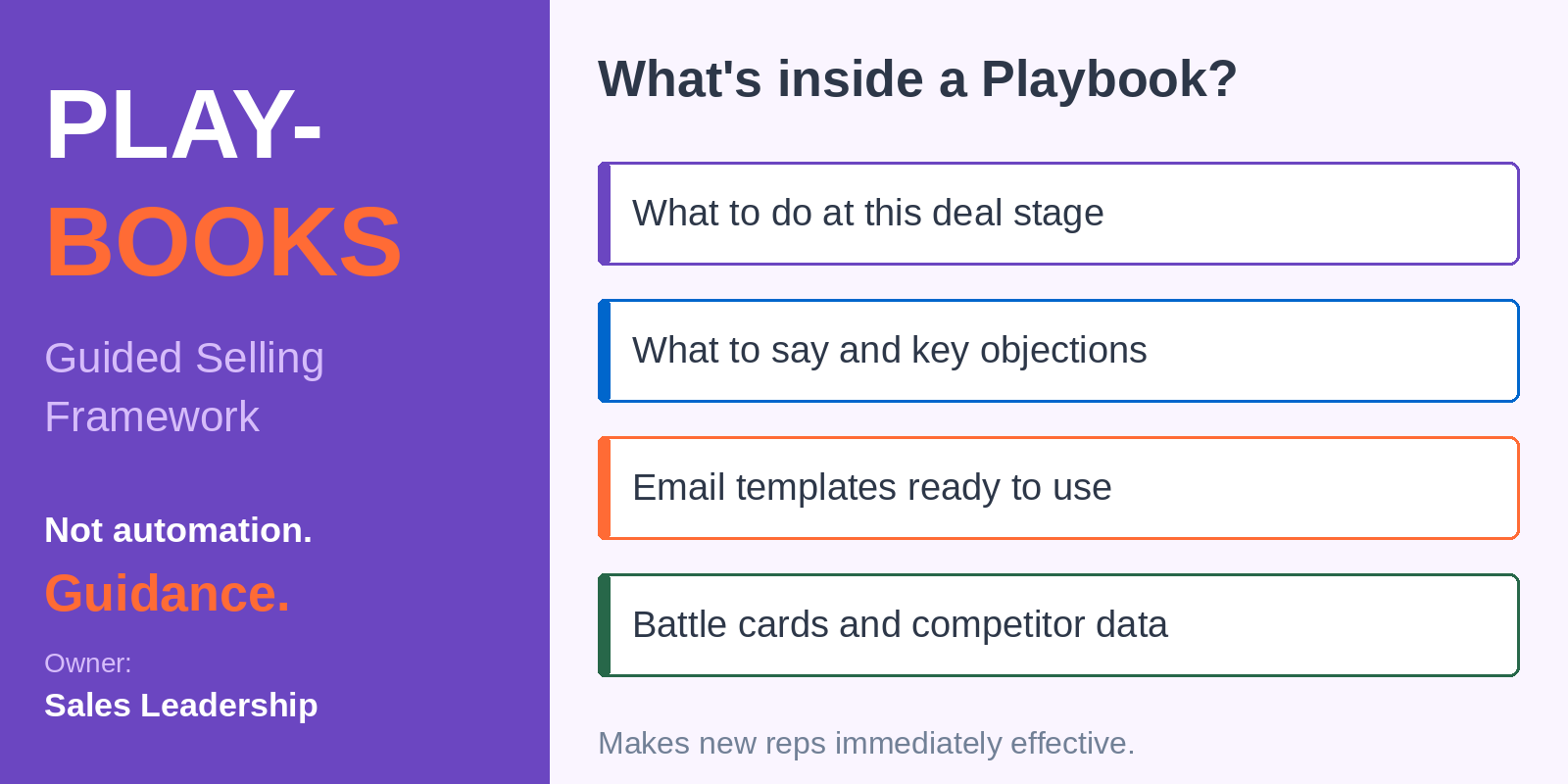
A Playbook is a coach. It's saying: this is what we've learned works in this situation. Here's what to do. Here's what to say. The rep is still doing all the work. But they're not guessing about what to do next. They're executing a proven playbook.
Here's what we love about Playbooks: they make your team better immediately. A new sales rep can look at the playbook and know what to do. An experienced rep can use the playbook as a reminder. And across your whole team, everyone's following the same approach, which creates consistency.
Who owns Playbooks? Usually sales leadership and sales enablement. They codify what works and make it available to the team.
When should you use a Playbook? When you want to guide your sales reps through a process. When you want to codify best practices. When you want consistency across your team. When you want to make your team better without hiring more people.
When should you NOT use a Playbook? When you're trying to automate something. When you're trying to send emails automatically. When you're trying to create a nurture campaign. In those cases, use a Workflow or a Sequence.
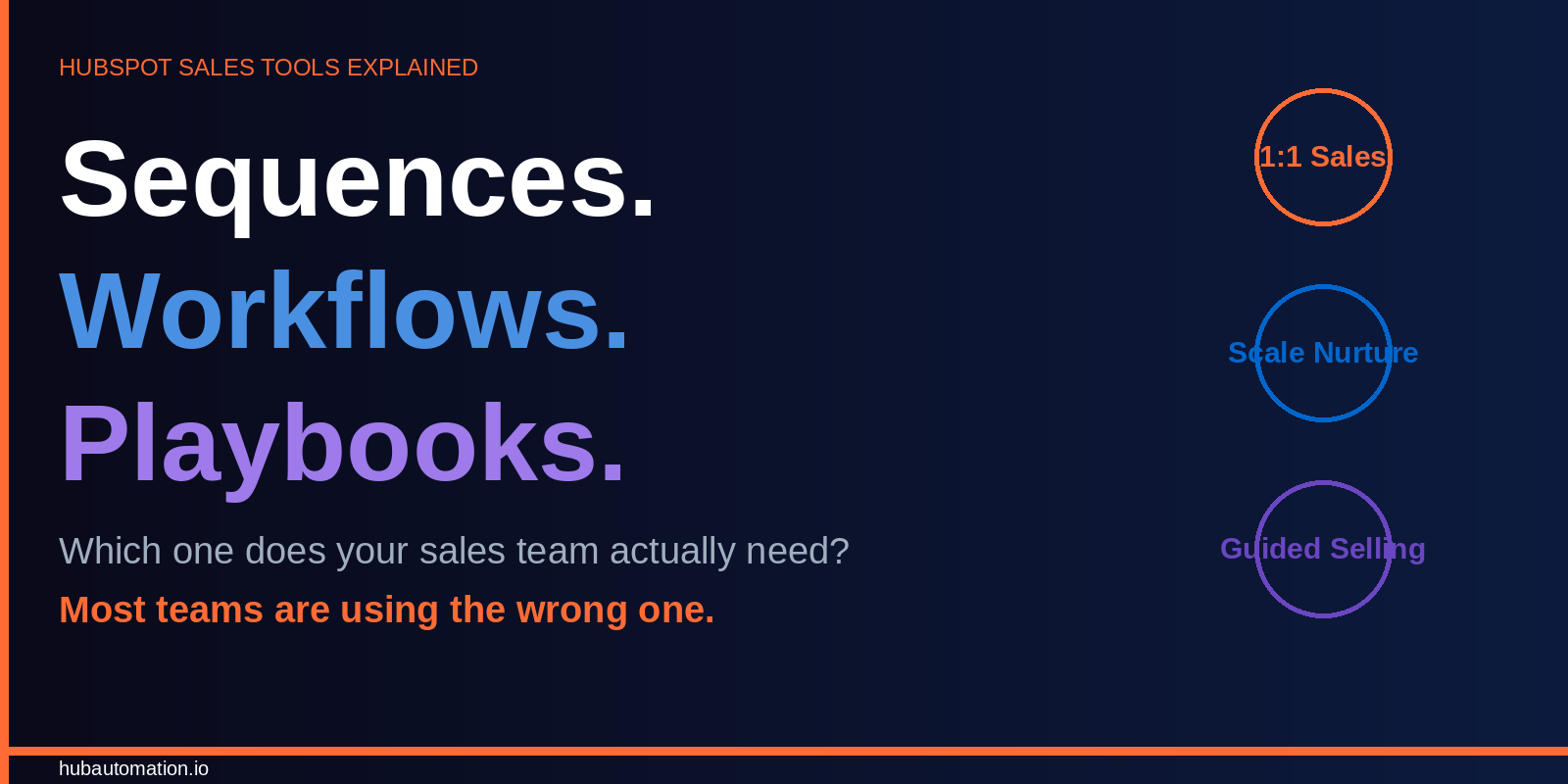
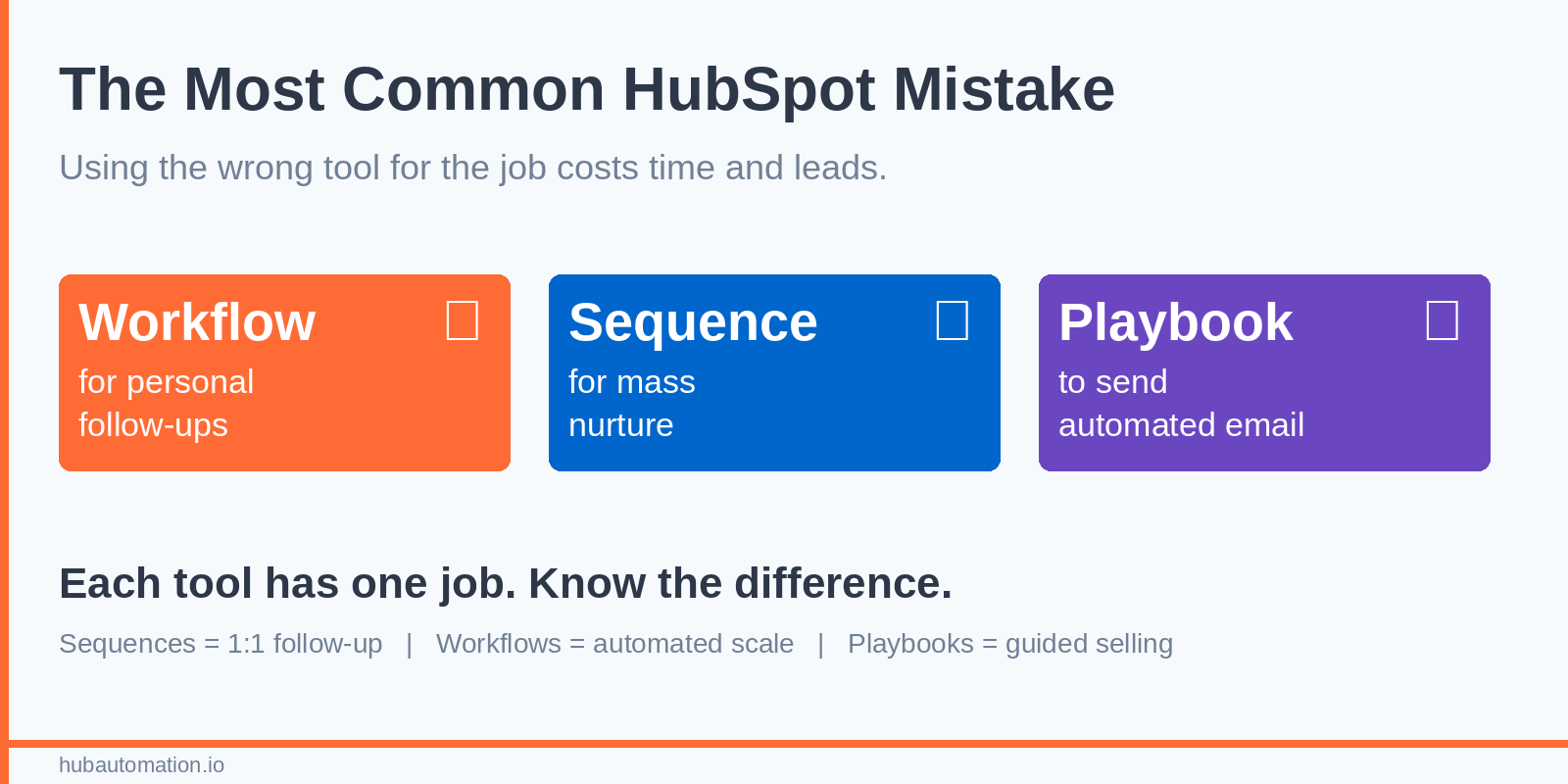
Sequences vs. Workflows vs. Playbooks. Most teams are using the wrong one for what they're trying to accomplish. Sequences are for one-to-one personal follow-up. Workflows are for automated nurture at scale. Playbooks are for guided selling. Know which tool you need before you start building. Want a deeper dive into how to actually use all three correctly in your HubSpot instance? We've built out training materials for all three. Check out our HubSpot Training Program.
Common Mistakes: The Things We See Teams Get Wrong
Now that we've explained what each one is, let's talk about the things we see teams do wrong. And honestly, these mistakes are super common.
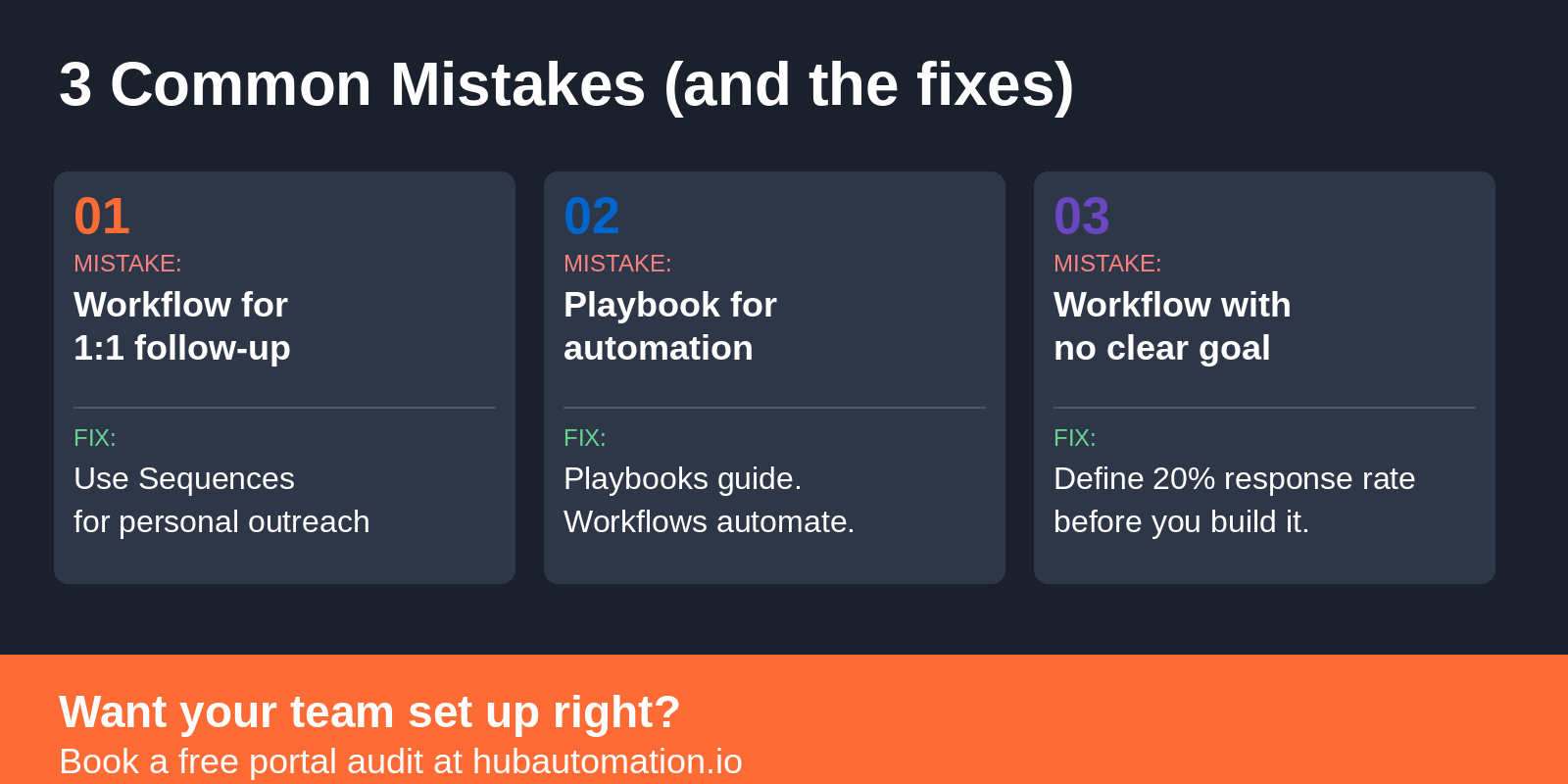
Mistake One: Using Workflows When You Need Sequences
This is the biggest one. A team says: "We want to automate our follow-ups so our reps don't have to remember." And someone says: "Let's build a Workflow!" And they build a Workflow that sends automated emails to everyone in a certain deal stage. And then they wonder why their reps aren't responding to the objections in those emails.
The problem: a Workflow sends the same automated email to everyone. It doesn't know that one prospect is concerned about implementation timelines and another prospect is concerned about pricing. A Sequence, which a rep is executing, can personalize the follow-up to address the specific objection.
So the rep looks like they're ghosting because the Workflow is sending automated emails but the prospect has questions that only a human can answer.
The fix: use Sequences for follow-ups with engaged prospects. Use Workflows for nurturing prospects who aren't ready to talk to sales yet.
Mistake Two: Trying to Do Everything in a Playbook
Some teams try to make Playbooks so comprehensive that they become useless. 47-page playbooks. Every possible scenario. Every possible objection. Every possible email template. And then nobody uses them because they're too much.
The best Playbooks we've seen are short. Maybe five pages. Three things to do at this stage. Two objections you'll probably hear. Two email templates. That's it. The rep can read it in two minutes and then execute.
Something we love: Playbooks should evolve. After three months, look at which reps are using the Playbook and which aren't. Look at which reps are winning deals. See what they're doing differently. Update the Playbook based on what's working. Make it shorter, more focused, more practical.
Mistake Three: Setting Up Workflows with No Clear Goal
A team will build a Workflow that sends a bunch of emails but nobody's really sure what success looks like. The Workflow just... sends emails. And prospects... maybe respond? Or maybe don't? There's no clear KPI.
The fix: before you build a Workflow, define success. "If we enroll 100 leads in this Workflow, we want 20 of them (20%) to respond and raise their hand for sales. And we want them to respond within 14 days so they're still hot." Then build the Workflow with that goal in mind. And then measure it. Did you hit that 20% response rate? If not, iterate on the emails, the timing, or the targeting.
That's how Workflows become effective. Not by accident. But by having a clear goal and iterating toward it.
Going Deeper: How These Tools Work Together
Here's where it gets really interesting. These tools aren't meant to be used in isolation. They work together.
Let's say you're running an inbound motion. Someone fills out a form. They get enrolled in a Workflow that's nurturing them automatically. After two weeks, if they've opened emails but haven't clicked a link, they're clearly interested but not quite ready to talk to sales yet. So the Workflow moves them into a different nurture track.
But if they've clicked a link, they're moved to a sales-ready pool. Now a sales rep picks them up. And the rep enrolls them in a Sequence. The Sequence handles the one-to-one follow-up with that prospect while also following a Playbook for how to approach that conversation.
So the Workflow did the heavy lifting of nurturing at scale. The Sequence is handling the personal follow-up. And the Playbook is guiding the rep on what to say.
That's powerful. That's also why most teams don't do it, it requires coordination and planning. But that's where the real ROI is.
And honestly, this is where a good RevOps function makes a difference. Because someone needs to own all three. Someone needs to make sure the Workflow is feeding qualified leads to Sequences. Someone needs to make sure the Playbook is being followed. Someone needs to measure whether any of it is working and optimize it.
What This Means For Your Sales Team
If your sales team is scattered across three different follow-up approaches, you're going to have inconsistent results. Some reps are using Sequences and closing deals. Some reps are relying on Workflows and getting frustrated because the Workflows are sending generic emails. Some reps don't know what a Playbook is because nobody's taught them.
When you align on which tool to use for what, everything gets better. Your reps know how to follow up. Your marketing team knows how to nurture. Your leadership team knows what's happening in the pipeline. And that's good for us. Because a well-run sales team, with clear tools and clear processes, closes deals.
And that's the whole game, right? Close deals. Do it consistently. Do it predictably. Everything else is just details.
The Bottom Line
Sequences, Workflows, and Playbooks are three different tools for three different jobs. Sequences are for one-to-one personal follow-up. Workflows are for automated nurture at scale. Playbooks are for guided selling. Know which one you need. Use it right. And then connect them together so they work as a system.
Your sales team will be better. Your reps will close more deals. And your revenue will be more predictable. And that's what we're after.
Want to get your team trained on all three? We've built out comprehensive HubSpot training that covers Sequences, Workflows, Playbooks, and everything else. No generic training. We customize it for your sales process. Get started here.
P.S. We also have a specific guide on building Playbooks that actually get used. Because the best Playbook in the world is useless if your reps don't know about it. That guide covers the common mistakes we see and how to avoid them.
Want to see where your blind spots are? We run free diagnostics for companies like yours.
Want to see where your CRM is leaking revenue?
We run free 30-minute HubSpot diagnostics. Your portal, on screen, live. You leave with a prioritized fix list, yours to keep whether you hire us or not.
| Book my free 30-min audit |